




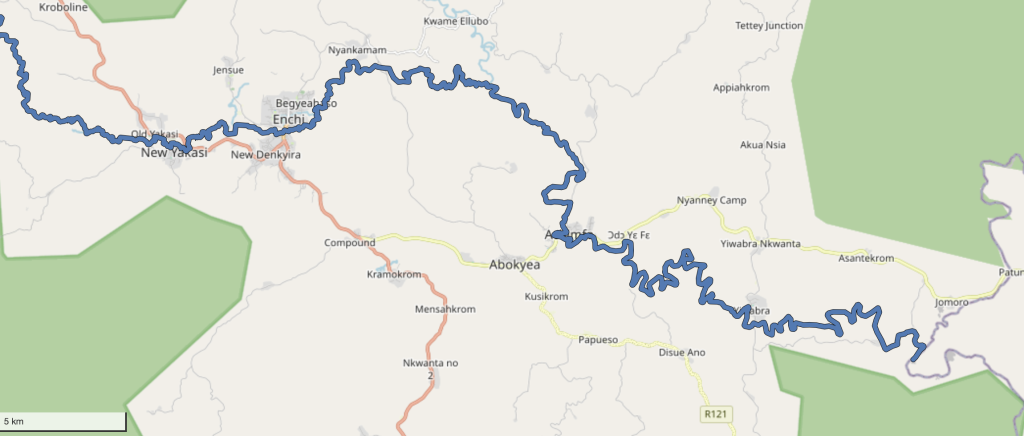
Beneath the towering canopies of the Ghanaian rainforest and winding through the ancestral lands of Aowin and beyond, flows a quiet but vital tributary—the River Disue. Though lesser-known than the Tano itself, the Disue plays a powerful role in sustaining ecosystems, feeding agricultural communities, and shaping local spiritual traditions within the Tano River Basin.
As illegal mining and deforestation spread deeper into Ghana’s forest frontier, rivers like the Disue are becoming the first to suffer—and the last to be remembered. It is time to shine a light on this hidden artery of the Tano River’s circulatory system.
📍 Location and Hydrological Context
- Country: Ghana
- Region: Western North Region (notably Aowin Municipality)
- Districts & Localities: Flows near Enchi and surrounding forested areas
- Connection: Tributary of the Tano River, draining into it from the east
- Protected Areas: Passes through or near key forest reserves such as Tano Nimiri, Tano Anwia, and Boin Tano
The River Disue is a secondary watershed but an essential one. Its clear, slow-moving waters originate in elevated rainforest zones, contributing year-round flow to the middle course of the Tano River.
🌱 Ecological Significance
Though small in size, River Disue nurtures life in multiple interconnected ecosystems. Its basin hosts a blend of riparian forests, wetland margins, and semi-deciduous forest corridors, supporting rare and localized species.
Flora
- Tall, moisture-loving trees including Antiaris africana, Nauclea diderrichii, and Uapaca guineensis
- Palm groves, raffia swamps, and undergrowth plants with medicinal value
Fauna (likely and observed in nearby reserves)
- Amphibians such as reed frogs, forest tree frogs, and caecilians
- Otters, duikers, and African civets often come to drink from its banks
- Home to numerous freshwater fish species, catfish, tilapia, and shrimp
- Attracts forest birds, including kingfishers, herons, and African jacanas
The riverine vegetation also provides critical ecosystem services—preventing erosion, filtering water, and serving as nesting habitat for birds and aquatic invertebrates.
🧭 Cultural and Spiritual Role
Among the Aowin people and neighboring Akan subgroups, the River Disue is more than water—it is sacred.
- Considered a “daughter” or “spirit-sister” of the Tano River in oral cosmology
- Rituals of purification, healing, and rain invocation are conducted at specific pools along its course
- Traditional beliefs hold that spirits or river gods inhabit its deepest bends
- Chiefs and elders recount stories of warnings, dreams, or guidance received near its banks
Preserving River Disue is therefore both an environmental and spiritual imperative—it is where the voice of water meets the memory of ancestors.
⛔ Environmental Threats
Like many minor tributaries in West Africa, River Disue is under growing threat, particularly due to its quiet profile and remote access.
1. Illegal Mining (Galamsey)
- Gold prospectors are increasingly active along its middle and lower stretches
- Sediment plumes, mercury runoff, and habitat destruction are already affecting water quality
2. Logging and Charcoal Burning
- Riparian forests are cleared for fuelwood or access roads, reducing shade and increasing water evaporation
- Removal of protective vegetation leads to bank collapse and siltation
3. Agricultural Expansion
- Cocoa farms and food crop plots are being extended to riverbanks
- Agrochemical runoff from herbicides and fertilizers is contaminating the water table
💚 A River Worth Protecting: Role in the Tano River Collective Project
River Disue may not yet appear in scientific journals or conservation reports—but its preservation is foundational to the health of the Tano River and its people.
The Tano River Collective Project recognizes River Disue as:
- A keystone tributary requiring ecological mapping and protection
- A cultural heritage site linked to ancestral identity and spiritual practice
- A community engagement opportunity to integrate traditional ecological knowledge into conservation
Recommended Actions:
- Conduct ecological assessments to inventory plant and animal life along its banks
- Identify sacred sites and collaborate with traditional authorities to strengthen cultural protections
- Launch a “Save River Disue” campaign under the Tano River Collective banner, featuring youth outreach, cleanup days, and oral history projects
- Support forest buffer restoration to protect the river from further degradation
- Advocate for legal recognition of Disue as a protected waterbody under Ghana’s environmental framework
📢 Conclusion: Rediscovering the Forgotten Tributaries
In the grand story of the Tano River, the River Disue is a quiet verse—but without it, the song falters. It is time we recognize that the health of great rivers depends on their smallest streams. Protecting Disue is not just about ecology—it is about memory, justice, and the right of future generations to drink from the same waters their ancestors once honored.
🌍 www.TanoRiver.com
River Disue: Where the Sacred Flows in Silence
Join the Tano River Collective Project—Help protect the unseen lifelines.


