



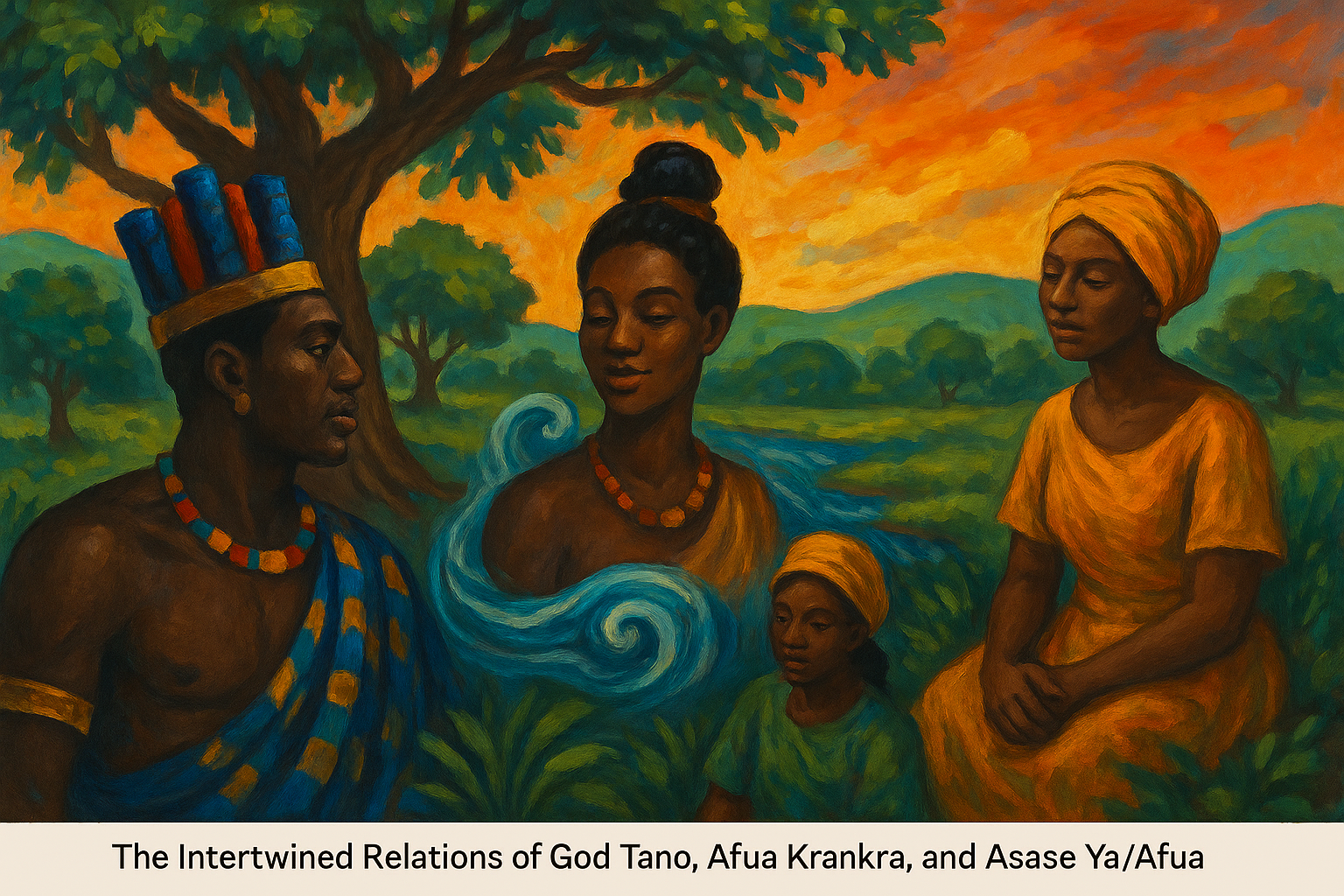
1. Introduction to Akan Cosmology and Key Deities
Akan cosmology is characterized by a meticulously structured divine hierarchy, with a supreme, omniscient, and omnipotent creator god at its apex. This supreme being is known by various names, including Nyame, Nyankopon, and Odomankoma, and is generally perceived as distant from direct human affairs. This foundational structure ensures a cosmic order where all existence originates from a singular, ultimate source.
Beneath the supreme being exists a pantheon of numerous lesser deities or spirits, collectively known as abosom. These abosom serve as vital intermediaries, receiving their power from the creator and assisting humans on Earth. They are frequently associated with the natural world, inhabiting water bodies, mountains, or the sky. Priests, known as
Ɔkomfoɔ, play a crucial role as mediators, communicating with the abosom on behalf of humankind. This organized divine hierarchy, with its specialized roles and clear lines of authority, mirrors and reinforces the structured nature of Akan society, where communal responsibilities and leadership roles are paramount. This divine framework provides a clear guide for human interaction with the spiritual world, indicating which deities to approach for specific needs.
Beyond the supreme being and the abosom, Akan spirituality also places significant veneration on Mother Earth, known as Asase Ya/Afua, and the ancestors. This comprehensive spiritual framework highlights a deep reverence for both the celestial and terrestrial realms, as well as the enduring connection to past generations.
Within this pantheon, three figures are particularly relevant to this inquiry: God Tano, the goddesses Afua Krankra, and Asase Ya/Afua. Tano, also known as Ta Kora, is a prominent abosom, identified as a powerful river god, a war deity, and a god of thunder and lightning. He is regarded as the highest and “king of all Obosom” , leading the
atano, the group of abosom associated with water bodies. Asase Ya/Afua is the revered Mother Earth goddess, embodying domains such as fertility, love, procreation, peace, truth, and serving as the Mother of the Dead. Afua Krankra is identified as a goddess whose attributes include conquest, bloodlust, brutality, war, and battle.
It is imperative to clarify the distinct identities of Afua Krankra and Asase Ya/Afua. The phrasing “goddesses Afua Krankra” in the user query suggests a potential conflation or misunderstanding between two separate divine entities. Research material unequivocally differentiates Afua Krankra as a singular war goddess and Asase Ya/Afua as the Mother Earth goddess, who is also Tano’s mother. This report will meticulously treat them as separate and distinct figures with unique relationships to Tano, providing a precise and nuanced understanding of their roles within Akan mythology.
Table 2: Familial Lineage of Tano and Asase Ya/Afua in Akan Mythology
| Deity (Generation) | Relationship | Primary Domains/Attributes |
| Nyame/Nyankapon/Odomankoma (Supreme Creator, Gen 1) | Creator of the universe, Supreme Being, Spouse of Asase Ya/Afua | Omniscient, Omnipotent, Distant Creator |
| Asase Ya/Afua (Mother Earth, Gen 2) | Wife of Nyame, Second to the Creator, Mother of the Dead, Mother of Bia, Tano, Epo, Anansi | Fertility, Earth, Peace, Truth, Procreation, Mother of the Dead |
| Tano (Gen 3) | Son of Nyame & Asase Ya/Afua, Husband of Afua Krankra | River God, War God, Thunder God, Strife |
| Bia (Gen 3) | Son of Nyame & Asase Ya/Afua, Elder brother of Tano | River God |
| Epo (Gen 3) | Child of Nyame & Asase Ya/Afua | Sea God |
| Anansi (Gen 3) | Child of Nyame & Asase Ya/Afua | Trickster, Wisdom, Creation of first inanimate humans |
| Afua Krankra (Gen 4) | Wife of Tano, Mother of 30+ child deities with Tano | Conquest, Bloodlust, Brutality, War, Battle |
| Tano & Afua Krankra’s Children (Gen 5) | Offspring of Tano and Afua Krankra, including deities of the Techiman-Bono state | Various localized divine influences |
Export to Sheets
2. God Tano: Attributes, Roles, and Core Myths
Tano, also known by his true name Ta Kora, is a profoundly significant river god originating from Ghana and the lower Ivory Coast. His epithet “Kora” signifies “the immense,” and “Ta” may derive from a word meaning “father,” reflecting his formidable presence. Within the Akan divine hierarchy, Tano holds an exceptionally high position, often regarded as the “highest and king of all Obosom”. He leads the
atano, the distinct group of abosom associated with water bodies such as rivers.
His parentage firmly establishes his foundational place in Akan cosmology. Tano is consistently identified as the second son of Nyame, the supreme being. More specifically, multiple accounts explicitly state that he is the son of both Nyame and Asase Ya/Afua, the Earth goddess. This direct mother-son relationship links Tano directly to the essence of Earth and creation, highlighting his integral role within the core divine family structure.
Tano’s primary domains are diverse and powerful. As a river deity, he represents the Tano River itself, with the epithet “Asuhyia Tano” signifying “The Blessed Waters of Tano”. Fish are considered his children, underscoring his deep connection to aquatic life and the vital role of water in sustaining existence. He is also a formidable war deity, invoked in times of military conflict and known as the
Abosom of war and strife. Tano is depicted as a strong warrior capable of shapeshifting and employing sophisticated military tactics, such as the “Captured on purpose” strategy, where he transforms into a small boy to infiltrate enemy kingdoms and spread pestilence. His heroic nature is evident in his fearlessness in battle. Furthermore, in Asante and Agni mythology, Tano is identified as the
Abosom of Thunder and Lightning, and was possibly once a thunder god. However, it is noted that in Fante mythology, Bobowissi holds this specific role. Beyond these specific roles, Tano is also recognized as a nature
abosom, further emphasizing his profound connection to the natural world.
The narratives surrounding Tano reveal a dynamic and evolving divine character, possessing a spectrum of attributes. Initially, he is portrayed as stubborn and even disrespectful towards Nyankapon, interfering in the supreme deity’s realm and displaying immense power through massive thunderstorms. However, later accounts describe a transformation, indicating he has become a “more peaceful deity” , valuing life and actively seeking peaceful resolutions before resorting to force. Despite his role as a war god, he is also depicted as merciful, willing to forgive witches who confess and vow to change. This complexity of character, capable of both cunning (as seen in the inheritance myth) and compassion, suggests that Akan mythology embraces a nuanced understanding of divine morality. Deities are not static archetypes of pure good or evil, but rather embody a range of human-like qualities, capable of growth and transformation. His enduring rivalry with Death (Owuo), despite being a war deity, further emphasizes his underlying role as a protector of life, highlighting a deep philosophical tension within his character.
Several key myths illuminate Tano’s character and influence. In the Asante version of the “Cheating Bia of Inheritance” myth, Tano, aided by the messenger goat Akua Abirekyi, cunningly disguised himself as his elder brother, Bia, to claim the fertile lands intended for Bia by Nyame. This deception resulted in Tano receiving the rich Asantelands, while Bia was left with the barren lands of central and western Ivory Coast, initiating a lasting feud between the brothers. Conversely, the Agni people recount a version where Bia cheated Tano. Another significant narrative is Tano’s “Rivalry with Death (Owuo).” This conflict led to a compromise where Death is allowed to accompany Tano whenever he visits the human realm. This ongoing struggle with death also contributed to Tano’s emergence as the Asante
abosom of war.
A foundational myth details Tano’s “Introduction to Humans and the Founding of Techiman.” Tano was first encountered by humans through Afia Ankomah, the youngest sister of Nana Takyi Fri. While fishing, she retrieved an object from her basket that caused darkness upon removal. Upon taking it home, she became possessed by the object, which identified itself as the river deity Asuo Tano. Tano then guided the family to his dwelling, protected by baboons, and imparted his laws. Afia Ankomah became Tano’s first priestess. Despite Nana Takyi Fri’s attempts to evade spiritual obligations, Tano persistently sent his children to possess family members, ultimately compelling Takyi Fri to accept his spiritual duties and establish the Techiman nation. This narrative establishes a clear causal link between divine will and the formation of human communities and political entities. Takyi Fri’s initial reluctance and Tano’s persistent interventions underscore the idea that divine decrees are not to be easily avoided. This strongly suggests that, within the Akan worldview, significant historical and political developments, such as the establishment of a nation, are not merely the result of human agency but are divinely ordained and guided. This divine foundation for political structures may have served to legitimize leadership and societal norms, framing them as extensions of a cosmic order.
Further myths include Tano’s direct intervention in human conflicts, such as the “Lowering of River Waters” during a battle with the Anyi people, enabling the Aowin to secure victory. He also played a pivotal role in the “Asante Gyaman War (1818),” where he and his sons transformed into small boys to infiltrate the enemy palace, leading to the Asante’s triumph.
Tano’s associated symbols and epithets further define his character. His animalistic symbols include baboons, believed to be his personal army and shrine guardians; fish, considered his children; crocodiles, serving as his messengers; elephants; and goats. His regalia includes several
Akrafena (swords), with two forming his emblem alongside a distinctive sword with two blades fused in the middle. He also wields a legendary gun named “Kodiawuo,” which translates to “Go eat and die” or “Pandemic,” signifying its destructive power. He is known by epithets such as “Asuhyia Tano” (The Blessed Waters of Tano), “Nana Ko Nim” (The One Who Wins Wars), and “Obomuhene” (King Within The Rock), reflecting his diverse domains and powers.
3. Goddess Afua Krankra: Identity and Attributes
Afua Krankra, also spelled Kanka Afia, holds a significant position in Tano’s immediate divine family as his explicitly identified wife. This marital bond signifies a powerful alliance between two deities associated with warfare, bringing together distinct aspects of conflict.
Her specific attributes consistently define her as a goddess whose domains include “conquest, bloodlust, brutality, war, and battle”. These attributes highlight a fierce and aggressive aspect of warfare, emphasizing the raw, destructive, and visceral realities of combat. While Tano, her husband, is a god of war and strife known for strategic thinking and a degree of mercy , Afua Krankra personifies the more unrestrained and intense elements of conflict. Their marital union, therefore, brings together these diverse facets of war, symbolizing the comprehensive and multifaceted nature of conflict within the Akan worldview. This divine partnership might also reflect gendered understandings of power and roles in conflict within Akan society, where both male and female energies are recognized as integral to the dynamics of warfare.
The union of Afua Krankra and Tano is notably fruitful, as they are said to have a substantial progeny, specifically “30 or so child deities”. Crucially, two of their children are identified as
Oman abosom, meaning deities of the Techiman-Bono state. This indicates their joint role in the propagation of divine influence and the establishment of regional spiritual governance. The detail regarding their numerous children is significant, as it suggests that divine power and influence are not static or solely concentrated in the major deities but are actively propagated and distributed through lineage. These numerous children likely function as localized manifestations or extensions of their parents’ powers, exerting influence in specific regions or over particular aspects of human life and governance. This mechanism allows for a more direct, specific, and intimate engagement with human communities at a regional or local level, ensuring continuous divine oversight, protection, and assistance in particular territories or for specialized needs.
Despite her significant marital connection to Tano and her clear domain as a war deity, the available research material offers very limited specific myths or detailed narratives concerning Afua Krankra’s individual actions or personal history beyond her stated attributes and marital status. Her presence is primarily noted in relation to Tano and her defined sphere of influence. This suggests that her role might be more archetypal or a personification of specific aspects of war rather than a deity with extensive personal narratives.
4. Goddess Asase Ya/Afua: Identity, Attributes, and Roles
Asase Ya/Afua, known by various names such as Asase Yaa, Asaase Yaa, Asaase Afua, Asaase Efua, and Aberewaa, is the profoundly revered Akan Mother Earth goddess. She is consistently identified as the wife of Nyame/Nyankapon, the supreme creator god. While one source mentions her as the daughter of Nyame (the female aspect of the Nyankapon-Nyame-Odomakoma trinity) , the predominant narrative establishes her as Nyame’s consort. Asase Ya/Afua holds a prominent position in the Akan pantheon, being considered second only to the supreme creator.
Her primary domains are multifaceted and fundamental to existence. She is the goddess of fertility, love, procreation, and the dry and lush earth. As the nurturer of the earth, she is credited with providing sustenance for all living beings. Her worship is deeply integrated into agricultural practices, with libations poured to her for permission to till the land and to ensure abundance. She is also the goddess of peace and truth. Lying is considered a taboo against her, and individuals seeking to prove their honesty often touch the earth and recite prayers in her name. Significant sacrifices are mandated to appease her when human blood is intentionally spilled, emphasizing her role in maintaining peace and order.
Asase Ya/Afua is also known as the Mother of the Dead , governing the gateway to Asamando, the Akan Ancestral Realm. At death, she reclaims humanity, her mortal children, and libations are poured during funeral rites to ensure her acceptance and protection of the deceased on their journey to Asamando. This profound duality in her manifestations—Asase Afua, the youthful and beautiful aspect, as the goddess of fertile places, procreation, and the source of all humanity , and Asase Yaa, the old woman or Aberewaa, associated with barren lands and the “Mother of the Dead” —suggests that, within Akan thought, life and death are not opposing forces but rather intrinsic, interconnected phases of a continuous cycle, with Mother Earth serving as the central facilitator. This dualistic representation highlights a holistic Akan understanding of existence, where creation and dissolution are inseparable aspects of a single, cyclical reality. The deep reverence shown to her, despite the absence of dedicated temples, through practices like worshipping in agricultural fields and pouring libations directly onto the earth , underscores a pervasive spiritual connection to the land itself as a living, sacred entity that governs the fundamental transitions of life and death. This also implies that human well-being and societal order are inherently tied to respecting and maintaining balance with the natural environment.
Key myths explain the “Separation from Nyame.” One prevalent version recounts that a person (sometimes implied to be Asase herself or humans) repeatedly hit Nyame with a pestle while pounding yam, annoying him to the point where he transformed into Ananse Kokroko (Great Spider) and ascended to heaven, thus separating himself from Earth. Attempts to reunite with Nyame by building a tower of mortars failed, leading to a permanent separation. Another variant suggests human activities like cooking smoke and cutting pieces of the sky annoyed Nyame, causing him to retreat further from Earth. This narrative establishes a direct causal link between human behavior and the divine realm, specifically impacting the accessibility and direct interaction with the supreme creator. The “loss of paradise” is thus presented as a consequence of human folly. As a result of this separation, the
abosom (like Tano) become necessary intermediaries between the distant Nyame and humanity. This serves as a powerful cautionary tale within Akan tradition, emphasizing human responsibility for maintaining harmony with both the divine and the natural world. It illustrates that human actions have profound cosmic consequences, directly influencing the relationship between humanity and the supreme being. The emergence and necessity of
abosom as mediators is a direct ripple effect of this foundational myth, highlighting a theological framework where direct divine access is curtailed by human failings, thereby necessitating a structured system of intercession and ritual to maintain cosmic balance and receive divine assistance.
Another myth, “Asase and her Magical Sword,” details Asase’s possession of a long, sharp sword that could fight autonomously. This sword would slaughter enemies when commanded but would only stop when told to “cool down.” Ananse, the trickster, stole this sword and offered it to Nyame for protection. When an enemy army approached, Ananse commanded the sword to fight, and it annihilated the forces. However, Ananse forgot the command to stop the sword, and with no enemies left, it turned on Nyame’s army and eventually killed Ananse himself. The sword then embedded itself into the ground, becoming a plant with sharp leaves that cuts anyone who touches it, as no one has ever given it the command to stop.
Regarding worship practices and cultural significance, it is unique that no temples are dedicated to Asase Ya/Afua; instead, she is primarily worshipped in agricultural fields, underscoring her direct connection to the land and its productivity. Her sacred day varies by subgroup: Thursday is reserved for Asase by the Asante, Bono, and most other Akans, while Friday is observed by the Fante and a few others. On these days, tilling the land is traditionally abstained from. Rituals include pouring libations and offering sacrifices (such as fowls and cooked food scattered in four directions) to seek her permission for farming activities, for protection, and during funeral rites. The color brown is associated with Asase due to its link to clay, which is considered a healing and purifying agent in Akan culture.
5. Interconnections and Relationships: Tano, Afua Krankra, and Asase Ya/Afua
The relations between God Tano, Afua Krankra, and Asase Ya/Afua are deeply interwoven within the Akan mythological framework, illustrating a complex divine family structure that encapsulates fundamental cosmic forces.
The most direct connection is the marital bond between Tano and Afua Krankra. Afua Krankra is explicitly identified as the wife of Tano (Ta Kora). This union signifies a powerful alliance between two deities associated with warfare. Their marriage is fruitful, as they are said to have approximately “30 or so child deities”. Notably, two of their children are identified as
Oman abosom, significant deities of the Techiman-Bono state. This detail regarding their numerous children indicates that divine power and influence are not static or solely concentrated in the major deities but are actively propagated and distributed through lineage. These numerous children likely function as localized manifestations or extensions of their parents’ powers, exerting influence in specific regions or over particular aspects of human life and governance, ensuring continuous divine oversight and assistance in specific territories.
The relationship between Tano and Asase Ya/Afua is one of fundamental kinship: Asase Ya/Afua is unequivocally identified as the mother of Tano. This establishes a foundational familial link, placing Tano within the core divine family structure originating from the supreme creator. Both Tano and Asase Ya/Afua are children (or spouse and child) of Nyame, the supreme being. This common lineage underscores their foundational place in Akan cosmology and their inherent connection to the source of all creation.
Table 1: Key Attributes and Relationships of Tano, Afua Krankra, and Asase Ya/Afua
| Deity Name | Primary Domains/Attributes | Parentage | Consort/Spouse | Key Relationships | Associated Symbols/Epithets |
| Tano | River God, War & Strife, Thunder & Lightning, Nature God | Nyame & Asase Ya/Afua | Afua Krankra | Son of Asase Ya/Afua, Husband of Afua Krankra, Leader of atano | Baboons, Fish, Crocodiles, Elephants, Goats, Kodiawuo (gun), Akrafena (swords), “The One Who Wins Wars” |
| Afua Krankra | Conquest, Bloodlust, Brutality, War, Battle | N/A (Limited information) | Tano | Wife of Tano, Mother of 30+ child deities with Tano | N/A (Limited information) |
| Asase Ya/Afua | Fertility, Earth (dry & lush), Love, Procreation, Peace, Truth, Mother of the Dead | Nyame/Nyankapon | Nyame/Nyankapon | Mother of Tano & Bia, Wife of Nyame | Antelope, Aberewaa (“Old Mother Earth”) |
A comparative analysis of their roles reveals both overlaps and distinct specializations. While both Tano and Afua Krankra are powerful war deities, their specific attributes delineate distinct aspects of conflict. Tano is the Abosom of war and strife, known for his strategic military tactics, his heroic nature, and even his capacity for mercy. His rivalry with Death also positions him as a protector of life, even in the context of war. Afua Krankra, on the other hand, is defined by attributes of “conquest, bloodlust, brutality, war, and battle”. Her description emphasizes the more visceral, aggressive, and destructive elements of warfare. Their marital union can be interpreted as a symbolic representation of the complete spectrum of warfare in Akan thought, encompassing both the calculated strategy and the raw, violent realities of conflict.
The relationship between Tano and Asase Ya/Afua also highlights a crucial ecological and spiritual partnership. Asase Ya/Afua, as Mother Earth, is fundamentally associated with fertility, peace, and the cyclical nature of life and death, providing the very foundation for existence. Tano, her son, is a powerful river god, representing vital water bodies. Rivers are indispensable for sustaining life and ensuring the productivity of the land. This mother-son relationship highlights the deep Akan reverence for natural elements and their intrinsic interconnectedness in sustaining life. Tano, as a water deity, brings life-giving water to the land, which is overseen and embodied by his mother, the Earth goddess. This forms a crucial ecological and spiritual partnership, where the flow of water (Tano) nourishes the earth (Asase Ya/Afua), enabling fertility and life. Tano’s leadership of the
atano (water gods) means he governs a fundamental aspect of the natural world that falls under the broader, overarching domain of his mother, Asase Ya/Afua, reinforcing the hierarchical yet symbiotic relationship between them.
The core familial relationships among these deities—Nyame and Asase Ya/Afua as primordial parents , Tano as their son , and Afua Krankra as Tano’s wife —reveal that the fundamental forces governing the universe are not disparate but are intimately interwoven through divine kinship. Asase Ya/Afua represents the very ground of existence, fertility, and the life-death cycle. Tano, her son, embodies powerful natural phenomena (rivers, thunder) and the force of war. His marriage to Afua Krankra, another war deity, further amplifies the theme of conflict within this foundational divine structure. This intricate familial web suggests that creation, sustenance, and conflict are inherent and interconnected aspects of the world, all stemming from the same divine origins that provide life and order. The presence of powerful war deities within this core lineage implies that conflict is not an external aberration but an intrinsic part of the cosmic design, divinely sanctioned or understood. This perspective may reflect the historical realities and importance of warfare in Akan societies, elevating it to a divinely integrated and managed aspect of existence, rather than a purely destructive force.
6. Conclusion
The research comprehensively clarifies that God Tano, Afua Krankra, and Asase Ya/Afua are distinct yet profoundly interconnected figures within the rich tapestry of Akan mythology. Asase Ya/Afua stands as Tano’s mother, embodying the revered Mother Earth goddess, whose domains encompass fertility, peace, truth, and the fundamental cycle of life and death. Her dualistic representation as both fertile and barren reflects the comprehensive Akan understanding of existence as a continuous cycle. Afua Krankra is identified as Tano’s wife, a formidable goddess who personifies the more aggressive and brutal aspects of warfare, including conquest, bloodlust, and brutality. Tano himself is a powerful and multifaceted deity, serving as a river god, a strategic war deity, and a god of thunder. His character is depicted as evolving, and his myths are often foundational to the establishment of human communities and the delicate balance between life and death. Their intricate relationships illustrate a complex divine family structure that encapsulates fundamental cosmic forces: creation, sustenance, natural phenomena, and the multifaceted nature of conflict, demonstrating how these elements are interwoven in the Akan worldview.
These deities are central to the spiritual and cultural life of the Akan people, profoundly influencing daily practices, agricultural cycles, community governance, and their comprehensive understanding of life, death, and morality. Their interconnectedness reflects a holistic worldview where natural elements, human society, and divine will are intricately linked, providing a framework for understanding the world and humanity’s place within it. The divine hierarchy and familial bonds among these deities underscore the Akan perception of cosmic order as inherently structured and purposeful, with each divine entity contributing to the maintenance of the universe and human well-being. The establishment of human polities, such as the Techiman nation, is presented as divinely ordained, reinforcing the paramount importance of adhering to spiritual obligations for societal prosperity.
While the roles, attributes, and myths of Tano and Asase Ya/Afua are extensively detailed within the provided material, the information concerning Afua Krankra is comparatively sparse. Her presence is primarily noted through her marital status with Tano and a concise list of her war-related attributes. Therefore, further scholarly inquiry, potentially drawing from less widely documented oral traditions, ethnographic studies, or specialized religious texts, would be highly beneficial. Such research could aim to uncover more specific myths, rituals, or cultic practices associated with Afua Krankra, and to explore the nuances of her individual agency, influence, and unique narratives beyond her role as Tano’s consort. This would provide a more complete and nuanced understanding of her significance within the broader Akan pantheon and her specific contributions to the Akan understanding of warfare.Sources used in the report


