



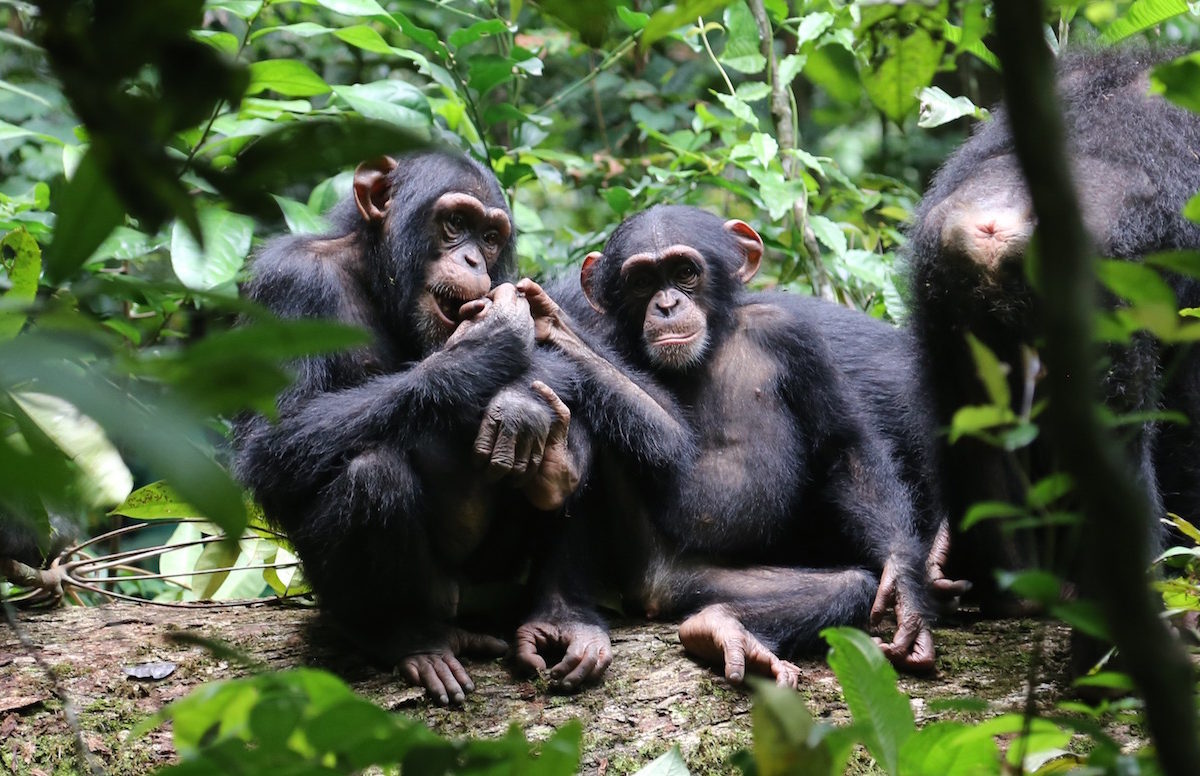
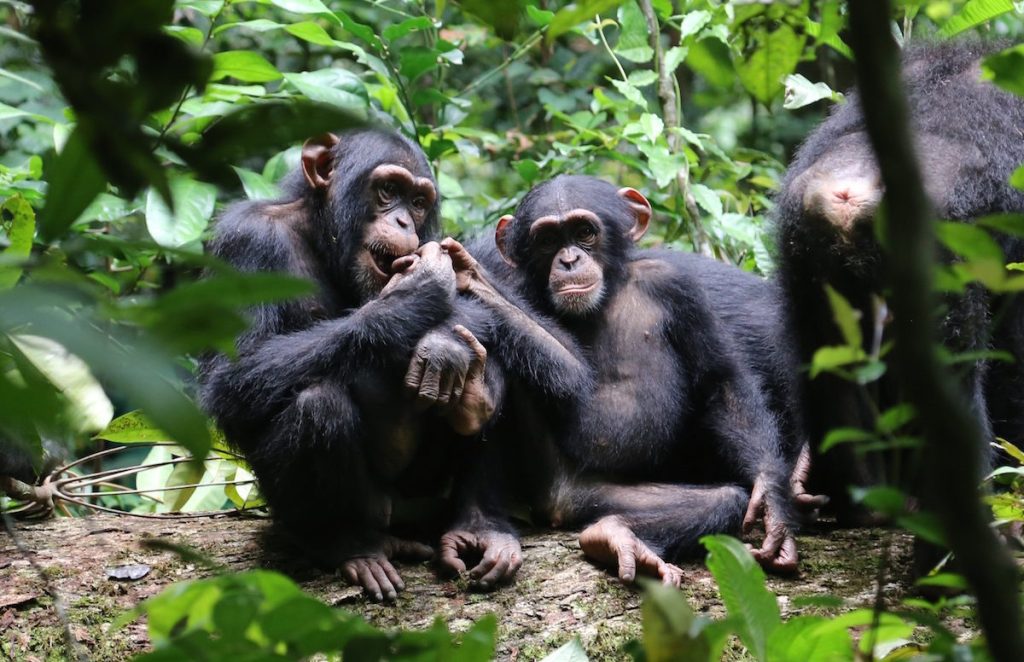
A thinking forest dweller, kin to humans and guardian of the Tano’s ancient trees
🔍 Quick Facts
- Common Name: Chimpanzee
- Scientific Name: Pan troglodytes
- Family: Hominidae
- IUCN Status: Endangered
- Size: 1.0–1.7 meters tall; 30–70 kg
- Activity: Diurnal (day-active), arboreal and terrestrial
- Lifespan: Up to 50 years in the wild
- Habitat: Tropical rainforests, gallery forests, and wooded savannas
🌍 Distribution and Habitat
Chimpanzees are found across Equatorial Africa, including remnant populations in:
- Côte d’Ivoire (especially in Taï National Park and Tanoé-Ehy Forest)
- Ghana, Liberia, Sierra Leone, and beyond
In the Tano River region, chimpanzees are:
- Reported in the Tanoé-Ehy Swamp Forest, one of West Africa’s last strongholds of undisturbed primate habitat
- Living in dense canopies, using elevated pathways to move and forage
- At risk from habitat destruction and isolation, but still present and culturally revered
🦍 Appearance and Behavior
- Fur: Black or dark brown, with a bare face and expressive eyes
- Build: Strong arms, capable of brachiation (swinging from trees)
- Gait: Walks on all fours (knuckle-walking), but can stand or walk upright briefly
- Social Structure: Lives in fission-fusion groups, where members come together and separate flexibly
- Communication: Uses a mix of vocalizations, facial expressions, gestures, and even tools
Chimpanzees have been observed using sticks to fish for termites, cracking nuts with stones, and displaying mourning rituals.
🌿 Diet
Chimpanzees are omnivores, with a mostly plant-based diet:
- Fruits, seeds, nuts, flowers, leaves, and bark
- Occasionally insects, bird eggs, and small mammals (including monkeys)
They play a vital role in seed dispersal and maintaining forest diversity.
🐣 Reproduction
- Mating is not seasonal, though births may peak during fruit abundance
- Gestation: ~230 days
- Infants are nursed for 3–4 years and stay close to their mother for up to 10 years
- Females give birth only every 5–6 years
Young chimps learn by observing and imitating older individuals — including how to use tools and navigate their environment.
🧭 Ecological and Cultural Significance
Chimpanzees are:
- Keystone species — crucial for seed dispersal and maintaining forest dynamics
- Genetically closest relatives to humans, sharing ~98.7% of our DNA
- Revered in many African cultures as sacred beings, ancestral spirits, or forest guardians
In Akan belief systems, chimpanzees may be associated with cleverness, community, and ancestral respect.
⚠️ Conservation Concerns
Chimpanzees are Endangered, with populations declining due to:
- 🌳 Habitat destruction (logging, farming, mining)
- 🔫 Poaching, including for bushmeat or the illegal pet trade
- 🧬 Disease transmission from humans
- 🧱 Forest fragmentation, cutting off group movement and genetic flow
In the Tano River Basin, illegal gold mining and agricultural expansion threaten critical habitat corridors.
🌊 Why It Matters for the Tano River
The presence of chimpanzees means:
- The Tano’s forests are still alive and functioning
- Ecosystems can still support top-level species and complex societies
- Conservation of the river includes not just water — but the deep forest minds that walk beside it
To protect chimpanzees is to protect a part of ourselves, and our ancestral mirror.
🔗 Do you know of chimpanzee sightings, stories from elders, or local efforts to protect forest apes? Help map their presence and inspire action at [TanoRiver.com/submit]


