



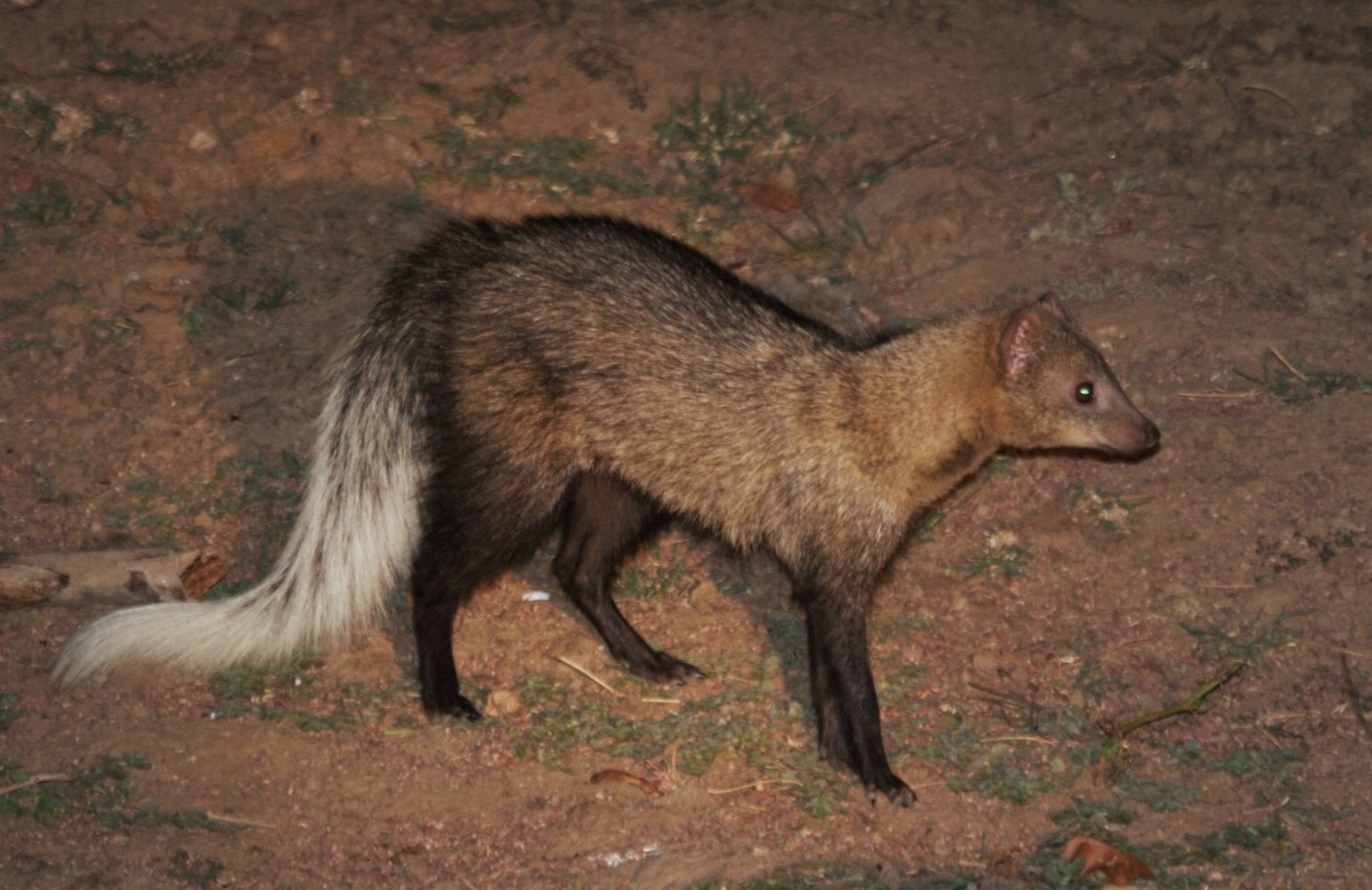
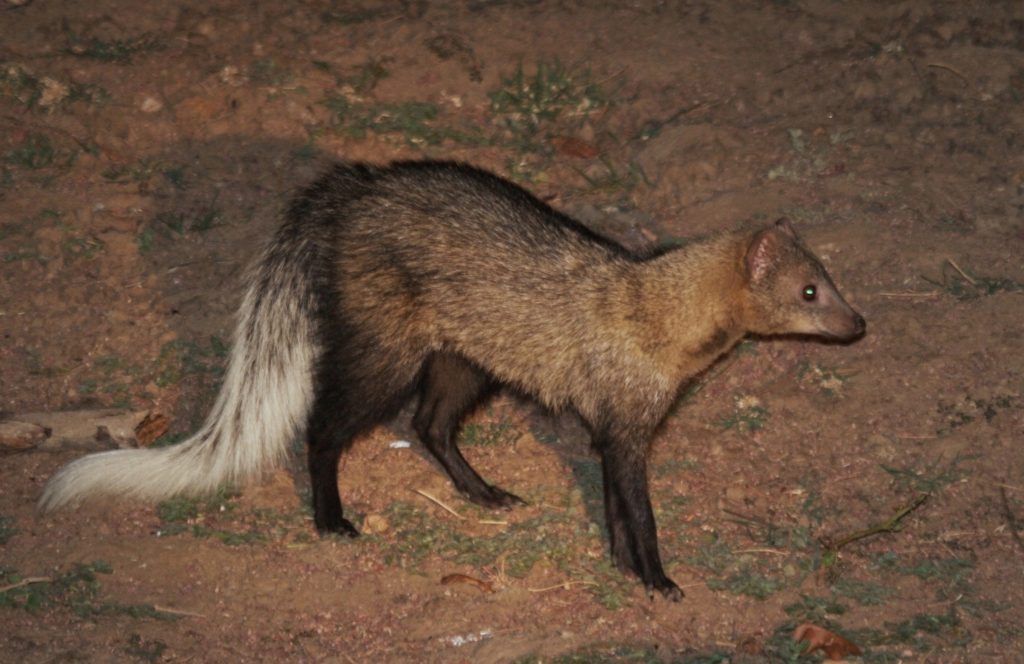
A stealthy night prowler of the Tano’s forest edges, marked by its striking tail and solitary habits
🔍 Quick Facts
- Common Name: White-tailed Mongoose
- Scientific Name: Ichneumia albicauda
- Family: Herpestidae (mongoose family)
- IUCN Status: Least Concern
- Size: Body length ~60–70 cm; tail ~40 cm
- Weight: 2.5–4.2 kg
- Activity: Nocturnal
- Habitat: Forest edges, savannas, riverine woodland, and farmlands
🌍 Distribution and Habitat
The White-tailed Mongoose is one of the most widespread mongoose species in Africa, including:
- Côte d’Ivoire, Ghana, Nigeria, and across sub-Saharan Africa
In the Tano River Basin, it likely roams:
- Along forest margins of the Tanoé-Ehy Swamp Forest
- Near village edges and abandoned farms
- Riverbanks and paths through dense undergrowth, hunting at night
It is elusive and rarely seen, but leaves distinctive tracks and white tail flashes at night.
🦊 Appearance
- Fur: Grey to dark brown, coarse and thick
- Tail: Long and bushy with a conspicuous white tip
- Body: Slender and elongated with a pointed snout
- Ears: Rounded; eyes shine orange-red in torchlight
The white tail is visible even in moonlight, used for signaling and confusion of predators.
🌿 Behavior and Diet
- Solitary and territorial
- Mostly active from dusk to dawn
- Diet:
- Insects (beetles, termites), rodents, frogs, reptiles, bird eggs
- Also scavenges carrion and raids poultry in rural areas
- Uses sharp claws and teeth to break into nests and burrows
Often follows forest trails or dry streambeds, silently foraging with nose to ground.
🐣 Reproduction
- Breeds year-round in some regions
- Gestation: ~60–70 days
- Litter size: 2–3 pups
- Young raised in burrows or hollow logs, remaining hidden for several weeks
Very little is known about its parenting behavior, due to its secretive nature.
🧭 Ecological Importance
The White-tailed Mongoose helps maintain balance by:
- Controlling rodent and insect populations
- Scavenging carcasses, keeping forest areas cleaner
- Acting as prey for large owls, leopards, and pythons
Its movements help disperse nutrients and affect small prey dynamics.
⚠️ Threats
While adaptable, it faces pressures near the Tano River such as:
- 🧱 Persecution, especially where it is blamed for poultry losses
- 🏞 Habitat fragmentation from farming and mining
- 🔥 Loss of cover, reducing hunting success and hiding places
- 🚧 Road mortality in areas where forest tracks intersect villages
Still, it remains resilient in mixed landscapes.
🌊 Why It Matters for the Tano River
The White-tailed Mongoose is:
- A symbol of ecological balance, living quietly on the edges of wild and human spaces
- An important predator and scavenger, contributing to ecosystem cleanup
- A sign of coexistence, surviving in both forest and farmland environments
Its glowing eyes and bright tail remind us that not all forest life sleeps when the sun goes down.
🔗 Have you seen glowing eyes near the river at night or found mysterious pawprints along trails? Share your stories at [TanoRiver.com/submit]


