



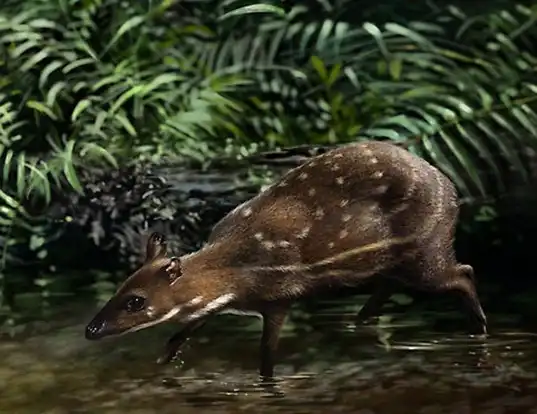
A shy, gliding spirit of West Africa’s riverside forests, walking the line between deer and mystery
🔍 Quick Facts
- Common Name: Water Chevrotain
- Scientific Name: Hyemoschus aquaticus
- Family: Tragulidae (Chevrotains or Mouse-deer)
- IUCN Status: Least Concern, but locally threatened
- Size: ~40–85 cm body length; ~7–16 kg
- Height: ~30–35 cm at the shoulder
- Activity: Nocturnal and crepuscular
- Habitat: Dense tropical lowland forests near water
🌍 Distribution and Habitat
The Water Chevrotain is native to the tropical rainforests of West and Central Africa, including:
- Côte d’Ivoire, Ghana, Liberia, Nigeria, and the Congo Basin
In the Tano River Basin, it likely inhabits:
- Riparian forest strips, especially near quiet tributaries and lagoons
- Dense undergrowth of the Tanoé-Ehy Forest Reserve
- Areas with low disturbance, where it can remain hidden
It avoids open spaces and is rarely seen, often known only by hoofprints and rustling.
🦌 Appearance
- Body: Rounded and compact, with short legs and arched back
- Fur: Reddish-brown with white horizontal stripes and spots on the flanks
- Eyes: Large and dark, adapted for low light
- Tail: Short and often flicking when alarmed
- No antlers or horns, but males have small curved tusks
It resembles a miniature deer, but is actually more ancient in lineage.
🌿 Behavior and Diet
- Nocturnal, emerging at dusk to forage
- Diet:
- Fallen fruit, mushrooms, leaves, and sometimes insects or crabs
- Uses streams and shallow water to escape predators — it is a surprisingly good swimmer
- Very secretive; prefers to freeze or bolt into cover when disturbed
Leaves behind small hoofprints with two pointed toes.
🐣 Reproduction
- Solitary except during mating
- Females give birth to a single fawn after a gestation of ~4–5 months
- Fawns are hidden in thick vegetation, with excellent camouflage
- Maturation is slow, and sexual maturity occurs around 9–12 months
Breeding behavior is still not fully observed in the wild.
🧭 Ecological Role
The Water Chevrotain contributes to forest health by:
- Spreading seeds from consumed fruit
- Supporting predators such as pythons, leopards, and crowned eagles
- Maintaining balance in the understory browsing community
It is also a living fossil, representing one of the most primitive ungulate lineages.
⚠️ Conservation Concerns
While globally Least Concern, the species is vulnerable in West Africa due to:
- 🪓 Deforestation and logging
- 🏞 Fragmentation of riparian corridors
- 🧱 Poaching for bushmeat
- 🔥 Habitat degradation due to mining and farming pressure
Its dependence on dense vegetation and water access makes it sensitive to change.
🌊 Why It Matters for the Tano River
The Water Chevrotain is:
- A symbol of ancient forest continuity
- A quiet guardian of riparian biodiversity
- A sign that the Tano’s forest-wetland linkages are still functioning
Its presence tells us the ecosystem is whole — from root to riverbank.
🔗 Have you found unusual hoofprints or seen a reddish flash vanish into the thickets at dusk? Report your sightings at [TanoRiver.com/submit]


