



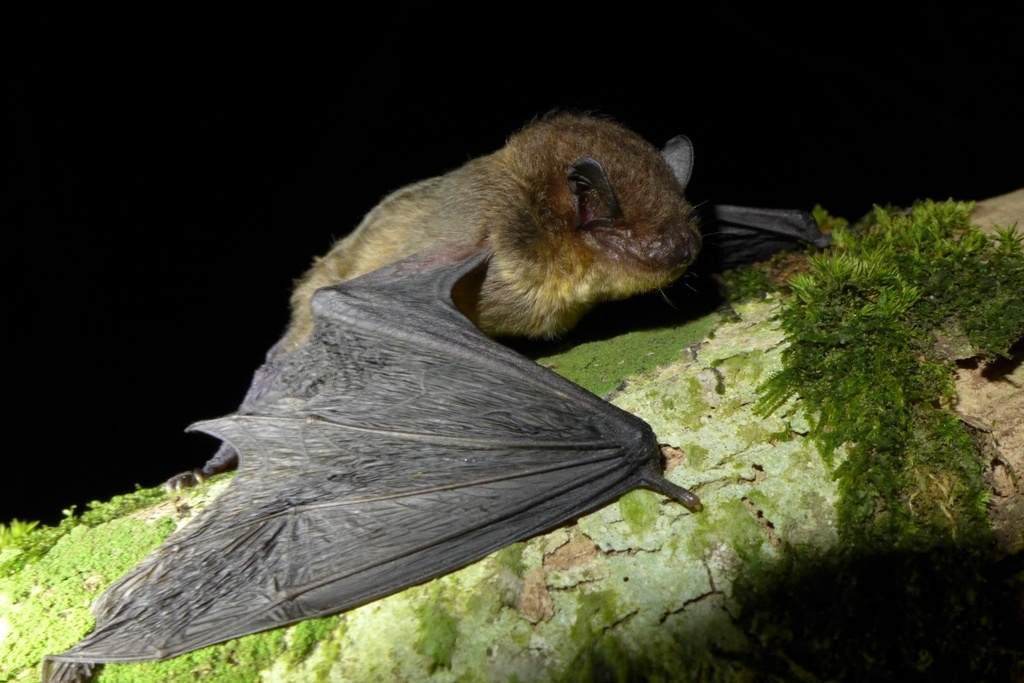
A miniature guardian of the night, fluttering softly across forest clearings and riversides
🔍 Quick Facts
- Common Name: Tiny Pipistrelle
- Scientific Name: Pipistrellus nanulus
- Family: Vespertilionidae (Evening bats)
- IUCN Status: Least Concern
- Wingspan: ~15–20 cm
- Body Length: ~3.5–5 cm
- Weight: 3–6 grams
- Activity: Nocturnal
- Habitat: Tropical forests, woodland edges, savannas, and riparian zones
🌍 Distribution and Habitat
The Tiny Pipistrelle is widely distributed in sub-Saharan Africa, including:
- Côte d’Ivoire, Ghana, Nigeria, Cameroon, Liberia, and beyond
In the Tano River Basin, it likely roosts and feeds:
- Along forest trails, riverbanks, and wetland edges
- Inside tree hollows, under bark, or in thatched roofs
- Near water bodies, where insects are abundant
It prefers sheltered roosting sites and emerges at dusk to forage in open airspace.
🦇 Appearance
- Fur: Brown or grayish-brown, sometimes with a slight reddish hue
- Face and ears: Small, with short rounded ears
- Wings: Narrow and short, built for agile, fluttering flight
- Tail: Short and partially enclosed in the tail membrane
Despite its size, it is a confident and efficient flyer, often feeding close to vegetation.
🌿 Behavior and Diet
- Diet:
- Flying insects such as moths, mosquitoes, beetles, midges
- Hunts using echolocation, emitting ultrasonic pulses while in flight
- Frequently seen dancing under canopy gaps or hovering near water
Its tiny size allows it to exploit microhabitats in dense forest.
🐣 Reproduction
- Breeding likely follows seasonal rainfall patterns
- Gestation: ~6–8 weeks
- Gives birth to 1–2 pups, which cling to the mother or remain in a warm roost
- Young reach flight capability in just a few weeks
Colonies are typically small and scattered, sometimes forming in shared shelters with other bat species.
🧭 Ecological Importance
The Tiny Pipistrelle contributes to:
- Insect population control, including vectors like mosquitoes
- Serving as prey for owls, snakes, and nocturnal predators
- Supporting ecosystem balance in wetlands, forest edges, and agroforestry zones
It is one of the quiet champions of mosquito regulation in the Tano basin.
⚠️ Conservation Concerns
Although listed as Least Concern, the species may face:
- 🪓 Deforestation and loss of natural roosting trees
- 🏠 Loss of traditional buildings, which sometimes offer alternative shelters
- 🧪 Insecticide use, reducing prey availability
- 🔍 Under-monitoring, due to its small size and subtle presence
Protecting small roosts, insect-rich corridors, and old trees is essential.
🌊 Why It Matters for the Tano River
The Tiny Pipistrelle is:
- A miniature engine of balance, flitting through night air over the Tano
- A vital part of the invisible food web between forest canopy and water
- A reminder that size does not equal significance in conservation
To protect this bat is to strengthen the web of life that connects trees, insects, water, and air.
🔗 Have you spotted small bats near your home or seen them flicker across a forest trail at dusk? Share your observations at [TanoRiver.com/submit]


