



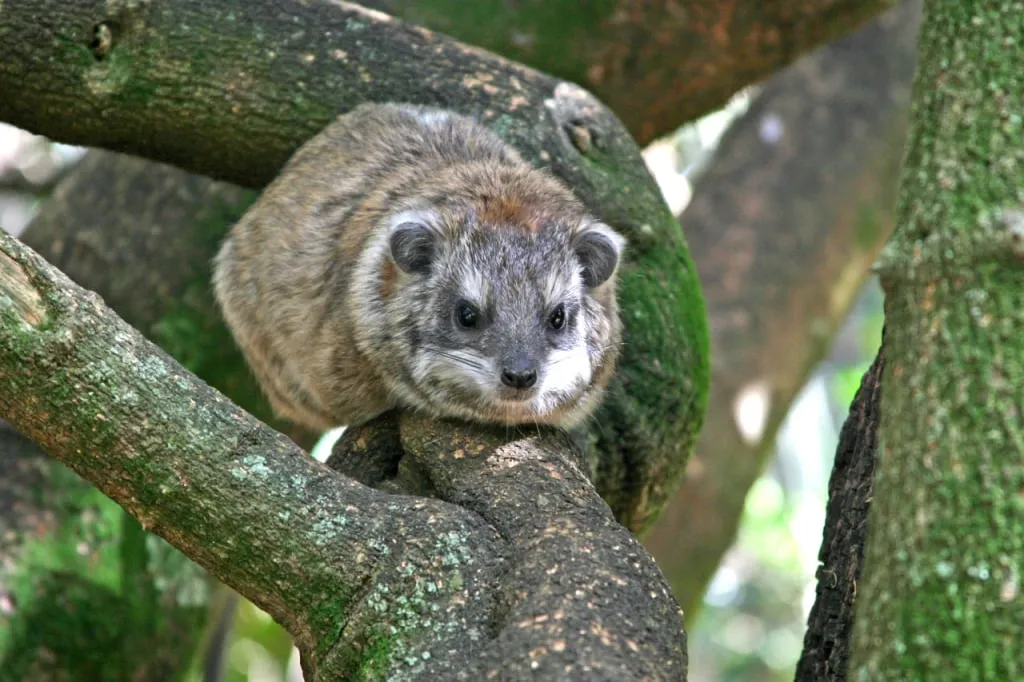
A mysterious night-caller of the Tano’s canopy, more often heard than seen
🔍 Quick Facts
- Common Name: Western Tree Hyrax
- Scientific Name: Dendrohyrax dorsalis
- Family: Procaviidae
- IUCN Status: Least Concern, but declining in many areas
- Size: 40–60 cm body length; 2–3.5 kg
- Activity: Nocturnal
- Habitat: Tropical forests, especially dense and mature canopy
🌍 Distribution and Habitat
Native to the Upper Guinean forests of West Africa, the Western Tree Hyrax is found in:
- Côte d’Ivoire, Ghana, Liberia, Sierra Leone, and Guinea
In the Tano River Basin, it is:
- Most likely encountered in Tanoé-Ehy Forest Reserve
- Living in tree hollows, canopy forks, and dense foliage
- Avoiding open areas, it relies on intact forest canopy to survive and hide
🐾 Appearance
- Fur: Gray to dark brown, dense and coarse
- Body: Rounded with short limbs and no visible tail
- Feet: Specialized rubbery soles for gripping tree bark
- Face: Small round ears, forward-facing eyes
Often mistaken for a rodent, it is more closely related to elephants and manatees!
🌿 Behavior and Diet
- Nocturnal and arboreal, almost never descends to the ground
- Diet:
- Leaves, bark, young shoots, and fruit
- Occasionally lichen and moss
- Highly vocal, producing haunting screams, barks, or moans after dusk
- Uses urine scent-marking and may have tree-top territories
It’s most often detected by its distinctive night-time cries, which can sound eerily human.
🐣 Reproduction
- Solitary or loosely social
- Gives birth to a single young, usually once a year
- Offspring develop slowly and stay hidden in tree cavities
- Parental care is extended and cautious
Because they are quiet during the day, their breeding behavior remains poorly understood.
🧭 Ecological Role
The Western Tree Hyrax plays a small but essential role in the forest:
- Consumes and prunes vegetation, influencing plant growth
- Provides food for large forest predators (eagles, leopards, pythons)
- Its tree-hollow nests are sometimes reused by birds or other mammals
Its loud vocalizations also help mark territory and contribute to forest soundscapes.
⚠️ Conservation Concerns
Though classified as Least Concern, it faces growing threats:
- 🌳 Deforestation and canopy fragmentation
- 🧱 Hunting for bushmeat, particularly near rural villages
- 🔥 Forest fires and agroforestry expansion
- ❌ Disturbance from logging roads that fragment high-canopy movement
It is rarely studied, so true population data may be underestimated.
🌊 Why It Matters for the Tano River
The Western Tree Hyrax is:
- A ghost of the canopy, signaling a forest still wild and deep
- A barometer of vertical forest integrity — if hyraxes are there, the trees are still connected
- A living link to Africa’s ancient ecological heritage
To hear its call in the night is to know that the upper branches of Tano still breathe.
🔗 Have you heard eerie screams at night in the forest, or seen round animals in treetops? Help track tree hyrax sightings at [TanoRiver.com/submit]


