



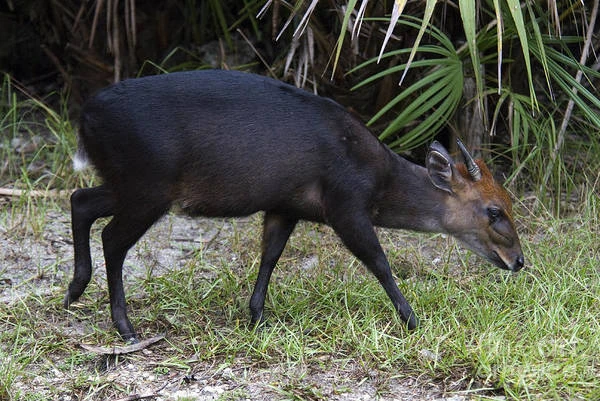
A secretive shadow of the Tano forest floor, quiet but essential to the life of the undergrowth
🔍 Quick Facts
- Common Name: Black Duiker
- Scientific Name: Cephalophus niger
- Family: Bovidae
- IUCN Status: Least Concern, but declining locally
- Size: ~50 cm shoulder height; 15–20 kg
- Activity: Diurnal (daytime active), often solitary
- Habitat: Dense tropical lowland forests and thick undergrowth
🌍 Distribution and Habitat
Native to West Africa, the Black Duiker is found in:
- Côte d’Ivoire, Ghana, Liberia, Sierra Leone, and Guinea
In the Tano River ecosystem, it is likely found:
- In undisturbed swamp forests of the Tanoé-Ehy Forest Reserve
- Along riparian corridors where forest density remains intact
- Near fallen fruit trees and leafy cover, where it forages undetected
It avoids open terrain and requires dense ground-level vegetation.
🦌 Appearance
- Color: Deep black or dark brown coat, often with a reddish tint on the back
- Face: Short snout with a distinct reddish forehead patch
- Horns: Both sexes have short, backward-curving horns
- Size: Smaller than savanna antelopes, with a stocky build
Its coloration helps it blend perfectly into the shadows of the forest floor.
🌿 Behavior and Diet
- Solitary, or seen in male-female pairs
- Travels along narrow tunnels in the vegetation
- Diet:
- Fallen fruit, seeds, leaves, fungi, and occasionally small insects or carrion
- Plays a key role in seed dispersal
Known for being elusive, it may freeze completely when startled before bolting.
🐣 Reproduction
- Breeds year-round
- Gestation: ~6.5 months
- Females give birth to a single fawn, which is hidden in thick vegetation
- Fawns are scentless and well-camouflaged, remaining still for days
Like other duikers, the young rely entirely on invisibility and silence.
🧭 Ecological Importance
The Black Duiker helps:
- Disperse seeds across the forest, supporting regeneration
- Shape the undergrowth through selective feeding
- Provide prey for leopards, eagles, and pythons
Its presence is a positive indicator of forest health and low human disturbance.
⚠️ Threats
While still listed as Least Concern, this duiker faces several local threats:
- 🏞 Habitat loss from farming, logging, and illegal gold mining
- 🔫 Poaching for bushmeat, even in protected areas
- 🧱 Habitat fragmentation, isolating populations
- ❌ Low reproductive rate, making recovery slow if populations are disturbed
In the Tano Basin, degradation of forest corridors puts this species at risk.
🌊 Why It Matters for the Tano River
The Black Duiker is:
- A symbol of forest quietness and resilience
- A key contributor to plant diversity and regeneration
- A reminder that some of the most important animals are the ones we rarely see
Protecting it means keeping the forest floor alive and balanced — a space essential to the river’s broader ecosystem.
🔗 Have you ever spotted this shy antelope or seen signs like tracks or droppings? Help us track their presence at [TanoRiver.com/submit]


