



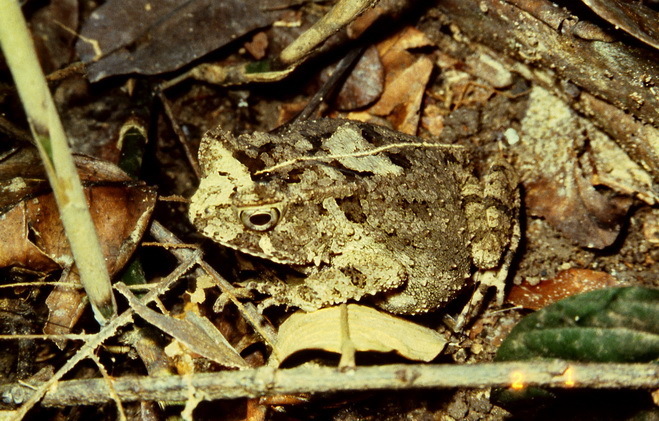
A rare, forest-dwelling toad from West Africa’s hidden wetlands, camouflaged in leaf litter and silence
🔍 Quick Facts
- Common Name: Togo Toad
- Scientific Name: Sclerophrys togoensis (formerly Amietophrynus togoensis)
- Family: Bufonidae (True toads)
- IUCN Status: Vulnerable
- Size: ~5–9 cm
- Activity: Nocturnal
- Habitat: Moist lowland forests, especially near small rivers and temporary pools
🌍 Distribution and Habitat
The Togo Toad is endemic to West Africa, including:
- Ghana, Togo, Benin, Côte d’Ivoire, and possibly parts of Nigeria
In the Tano River Basin, it may be found:
- In leaf-littered forest floors of the Tanoé-Ehy Forest Reserve
- Near small, shaded pools and seasonal forest streams
- In humid understory zones with minimal disturbance
Its camouflage and secretive behavior make it very difficult to observe.
🐸 Appearance
- Color: Brown to grayish-brown with dark markings; mottled or marbled texture
- Skin: Rough and warty, helping it blend into forest debris
- Parotoid glands: Prominent behind the eyes, typical of true toads
- Eyes: Horizontal pupils, well-adapted for low light
Its body is built for camouflage, not speed or display.
🌿 Behavior and Diet
- Nocturnal and reclusive — spends the day hidden under logs, rocks, or leaf litter
- Diet:
- Ants, beetles, termites, small invertebrates
- Uses a sit-and-wait hunting strategy, snapping prey with a sticky tongue
- Emerges during rainy nights to forage and breed
Its calls are soft and infrequent — heard only near temporary breeding pools.
🐣 Reproduction
- Breeds during the wet season in temporary pools or stream margins
- Males call from concealed positions
- Eggs laid in water; tadpoles develop quickly
- Requires undisturbed forest pools for successful breeding
Breeding is episodic and rainfall-dependent, making the species vulnerable to weather and habitat change.
🧭 Ecological Importance
The Togo Toad:
- Controls invertebrate populations in the leaf litter
- Provides food for snakes, birds, and small carnivores
- Acts as a bioindicator of healthy, moist forest ecosystems
- Participates in nutrient cycling, especially during tadpole stages
Its presence signals a resilient and intact forest microclimate.
⚠️ Conservation Concerns
The species is listed as Vulnerable due to:
- 🌳 Deforestation and habitat fragmentation
- 🛤 Disruption of forest floor microhabitats
- 🧪 Pollution and sedimentation of breeding pools
- 🔍 Lack of data, making protection strategies difficult
It is especially sensitive to the loss of ephemeral forest pools.
🌊 Why It Matters for the Tano River
The Togo Toad is:
- A forest specialist, tied to the Tano’s most secluded and moist zones
- A living relic of West Africa’s amphibian diversity
- A signal of how the smallest wetlands support irreplaceable species
Conserving the Tano’s shaded pools and intact understory helps protect this rare and quiet amphibian.
🔗 Have you heard a faint croak in the leaves or spotted a warty figure after the rain? Help document sightings at [TanoRiver.com/submit]


