



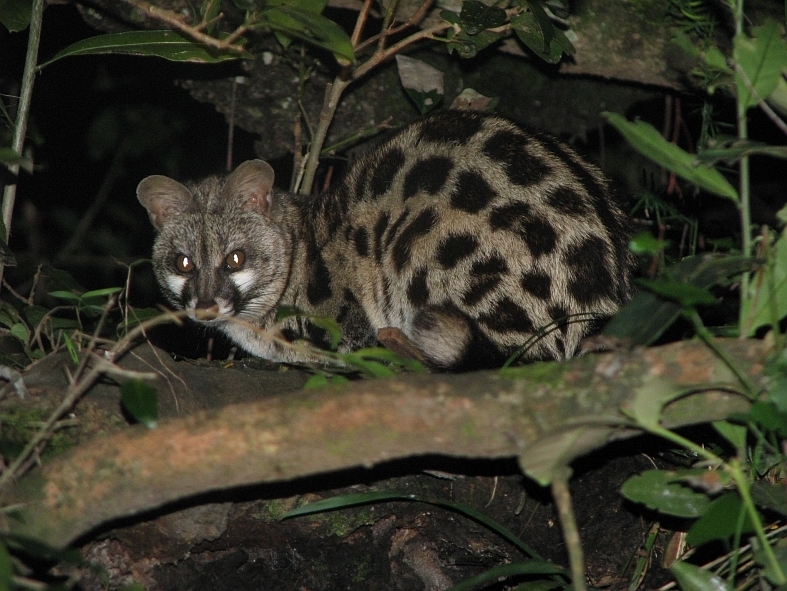
A regal shadow in the West African night, the King Genet weaves silently through the forest’s undergrowth and trees
🔍 Quick Facts
- Common Name: King Genet
- Scientific Name: Genetta poensis
- Family: Viverridae (genets and civets)
- IUCN Status: Least Concern
- Size: Body length ~40–55 cm; tail ~35–50 cm
- Weight: ~1.3–2.2 kg
- Activity: Nocturnal and solitary
- Habitat: Lowland rainforests, swamp forests, forest-savanna mosaics
🌍 Distribution and Habitat
Native to West and Central Africa, the King Genet is found in:
- Côte d’Ivoire, Ghana, Liberia, Cameroon, and surrounding countries
In the Tano River Basin, it likely thrives:
- In the Tanoé-Ehy Swamp Forest Reserve
- Along forest trails, canopy crossings, and near streams or wet clearings
- In areas with dense underbrush and tree cover, offering shelter and hunting grounds
This elusive mammal is rarely seen but leaves tracks, scat, or flashes of movement behind.
🐆 Appearance
- Coat: Pale grayish to yellowish with dark spots and rosettes along its body
- Tail: Long and banded with alternating dark and light rings
- Face: Pointed muzzle, large ears, and expressive eyes
- Build: Slender, with semi-retractable claws for climbing trees and gripping prey
Its elegant form and smooth movements make it a ghost of the canopy and undergrowth.
🌿 Behavior and Diet
- Nocturnal and solitary, emerging at night to hunt
- Diet:
- Insects, small rodents, birds, frogs, reptiles
- Fruits and eggs when available
- Moves stealthily and quickly, climbing trees and hunting on the ground
- Communicates via scent marking and low vocalizations
Despite being a predator, it avoids confrontation and prefers cover and stealth.
🐣 Reproduction
- Breeding may occur year-round
- Females give birth in tree hollows or dense thickets
- Litter size: 1–4 pups
- Young remain hidden until able to forage with the mother
Very little is known about its parenting behavior, adding to its mystery.
🧭 Ecological Role
The King Genet contributes to the forest ecosystem by:
- Controlling small mammal and insect populations
- Dispersing seeds from consumed fruits
- Serving as prey for larger predators like leopards, pythons, and crowned eagles
Its adaptability to different vertical layers (ground to canopy) makes it an important link between ecosystems.
⚠️ Conservation Concerns
While listed as Least Concern, threats include:
- 🌳 Deforestation and forest fragmentation, especially in coastal areas
- 🧱 Hunting and trapping for bushmeat or traditional uses
- 🚧 Loss of tree corridors, reducing movement and hunting territory
- 🔇 Low research attention, leaving population trends unclear
Protecting continuous forest cover is essential to its long-term survival.
🌊 Why It Matters for the Tano River
The King Genet is:
- A symbol of quiet balance, thriving in the space between darkness and light
- A reminder that the Tano’s forests still hold rare and graceful carnivores
- A silent predator, helping maintain rodent and insect balance in delicate ecosystems
To glimpse one is to know the forest is still wild.
🔗 Have you seen spotted animals at night, or found strange tracks in forest mud? Share your sightings at [TanoRiver.com/submit]


