



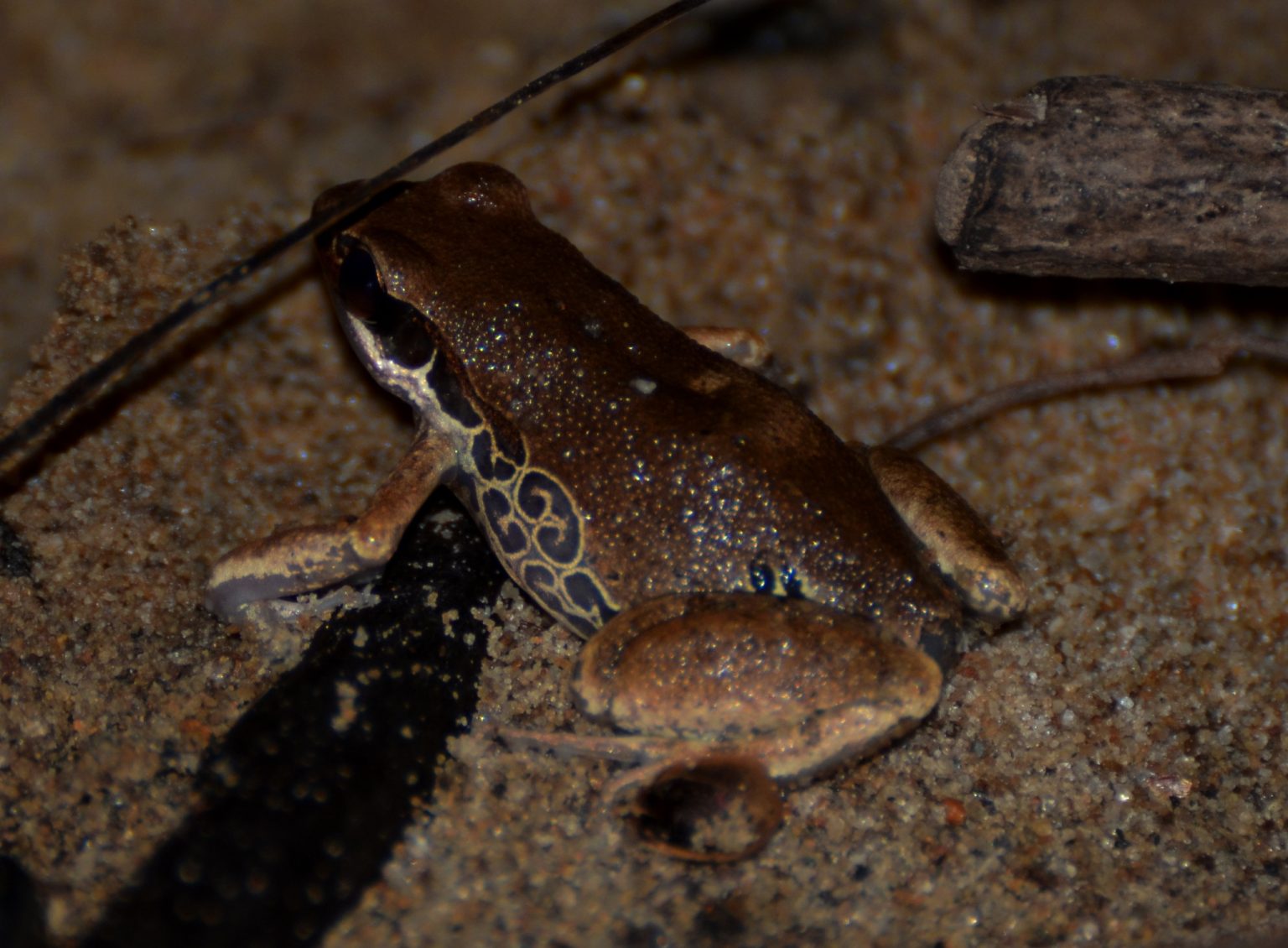
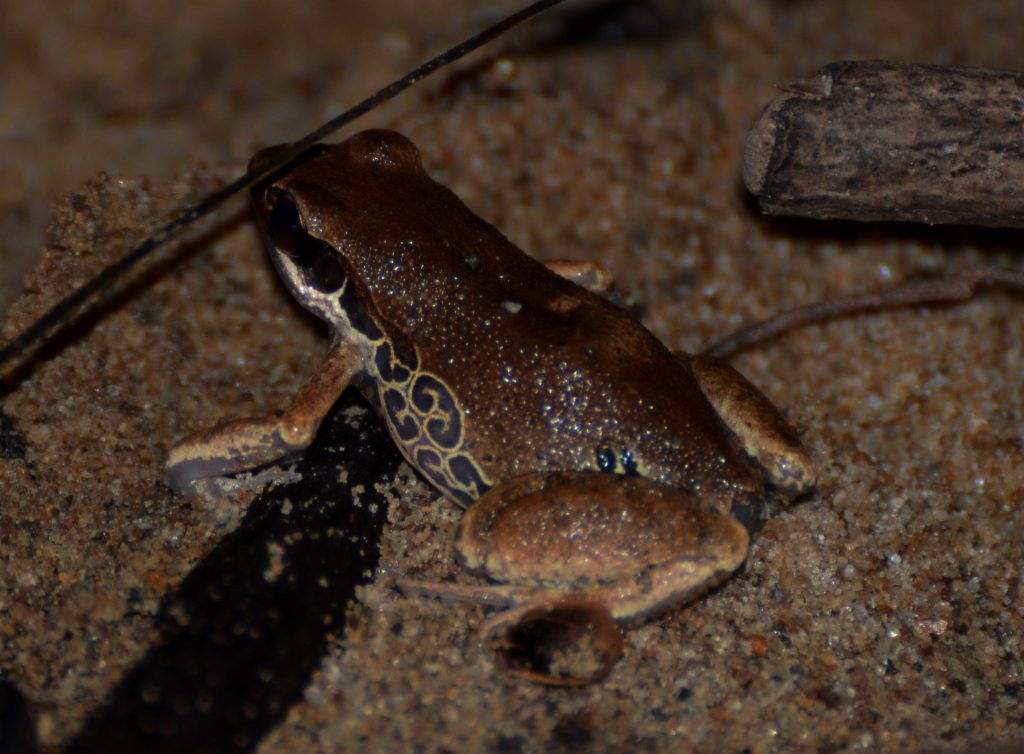
An agile forest dweller with a secret rhythm, echoing through the Tano undergrowth
🔍 Quick Facts
- Common Name: Leaping Long-fingered Frog
- Scientific Name: Cardioglossa leucomystax
- Family: Arthroleptidae
- IUCN Status: Least Concern
- Size: 25–35 mm (adults)
- Activity: Nocturnal and terrestrial
- Habitat: Lowland tropical rainforests, stream banks, and forest floor leaf litter
🌍 Distribution and Habitat
The Cardioglossa leucomystax is found in the Upper Guinean rainforests of West and Central Africa, including:
- Ghana, Côte d’Ivoire, Nigeria, Cameroon, and parts of the Congo Basin
In the Tano River ecosystem, it likely inhabits:
- Moist leaf-litter zones of the Tanoé-Ehy Forest Reserve
- Forest stream edges and shallow seasonal pools
- Understory microhabitats, especially where human disturbance is low
Its camouflage and small size make it extremely difficult to spot, even in well-surveyed areas.
🐸 Appearance
- Color: Brown or tan with dark lateral stripes and white facial markings
- Distinguishing Trait: Males have extremely long third fingers
- Body: Slender build with elongated limbs for jumping
- Eyes: Large and forward-facing, adapted for low-light vision
The species name leucomystax refers to the white stripe on the face—a key identifier.
🌿 Behavior and Ecology
- Nocturnal and secretive
- Active during wet seasons, especially after rainfall
- Males call from concealed spots near streams and puddles
- Diet: Small insects, ants, termites, and forest floor invertebrates
Their calls are soft trills or chirps, often masked by forest noise.
🪺 Reproduction
- Breeds in small, slow-moving forest streams or temporary pools
- Males call to attract females from concealed moist areas
- Eggs are laid in shallow water or wet leaf litter
- Tadpoles are aquatic, requiring clean, shaded water to develop
🧭 Ecological Importance
This frog is an important part of the rainforest micro-ecosystem:
- Controls populations of forest insects
- Provides food for snakes, birds, and mammals
- Indicates the health of riparian (stream) habitats
Its presence helps scientists understand how the forest floor is functioning.
⚠️ Conservation Concerns
Although classified as Least Concern, Cardioglossa leucomystax is locally threatened by:
- 🌳 Deforestation, especially near forest streams
- 🛢️ Water pollution from mining and agriculture
- 🧱 Habitat fragmentation, which isolates breeding populations
- 🔇 Lack of monitoring, making it easy to overlook population declines
Its breeding is tied to specific microhabitats, which are sensitive to even minor changes.
🌊 Why It Matters for the Tano River
The Leaping Long-fingered Frog is:
- A silent engineer of the forest floor
- A micro-indicator of water and soil quality
- A symbol of hidden biodiversity that thrives in the shadows and silence
Every leap it takes through the Tano forest reminds us: even the smallest species carry the forest forward.
🔗 Have you seen or heard tiny frogs near your forest streams? Know of shallow pools where frogs gather after rain? Share your knowledge at [TanoRiver.com/submit]


