



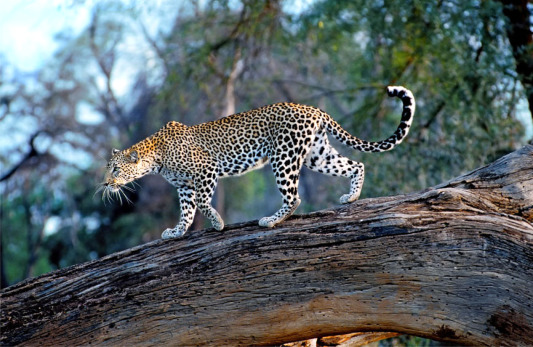
Stealth and strength in one shadow: the vanishing ruler of West Africa’s forests
🔍 Quick Facts
- Common Name: Leopard
- Scientific Name: Panthera pardus
- Family: Felidae
- IUCN Status: Vulnerable (globally), and possibly endangered in West Africa
- Activity: Nocturnal and crepuscular (active at dusk/dawn)
- Habitat: Forests, savannas, river valleys
🌍 Distribution and Habitat
The leopard once ranged widely across Africa, but today, West African populations are highly fragmented and rare. In the Tano River region, it may still be found:
- In dense forests like the Tanoé-Ehy Swamp Forest (Côte d’Ivoire)
- In remote patches of canopy along the Ghana–Côte d’Ivoire border
- Possibly in undisturbed riverine corridors, especially near protected areas
It requires large, connected habitats with dense cover and prey availability.
🐆 Appearance and Adaptations
- Size: 50–80 kg in West Africa (males), smaller than East/Southern African leopards
- Color: Golden-yellow coat with distinctive black rosettes
- Tail: Long and muscular for balance
- Eyes: Excellent night vision
Leopards are stealth hunters, able to stalk and pounce with surgical precision.
🌿 Behavior and Diet
- Solitary and highly territorial
- Hunts by stealth, often ambushing from trees or dense underbrush
- Diet: Extremely adaptable; includes:
- Duikers, monkeys, bush pigs, rodents, birds, and reptiles
- Will also scavenge and sometimes take livestock (in human-edge zones)
Leopards are known for dragging their prey into trees to avoid scavengers.
🐾 Reproduction
- Breeds year-round in tropical forests
- Females give birth to 2–3 cubs in hidden dens
- Cubs stay with their mother up to 18–24 months
Young leopards learn by following and observing their mother on hunts.
🧭 Cultural and Ecological Importance
In Akan, Nzema, and other forest cultures:
- The leopard is a symbol of power, royalty, and guardianship
- Featured in proverbs, totems, and storytelling
- Sometimes associated with river spirits or ancestral protectors of sacred lands
Ecologically, it is a keystone predator:
- Keeps prey populations in check
- Shapes animal behavior and movement patterns
- Supports a balanced forest ecosystem
⚠️ Threats
In the Tano region, leopards face:
- 🚫 Habitat destruction due to mining, logging, agriculture
- 🔫 Poaching for skins, bones, and retaliation killings
- ❌ Loss of prey base, especially duikers and monkeys
- ⚠️ Human-wildlife conflict near farmlands
Their stealth makes them rarely seen, but their absence can unravel the ecosystem.
🛡️ Conservation Status
- Listed as Vulnerable globally, and Critically Endangered in many West African countries
- Protected under CITES Appendix I
- May still survive in:
- Tanoé-Ehy Reserve (Côte d’Ivoire)
- Ankasa Conservation Area (Ghana)
- Undocumented forest corridors between
Needs:
- Strong anti-poaching enforcement
- Community-led habitat protection
- Better data through camera trapping and monitoring
🌊 Why It Matters for the Tano River
The leopard is:
- The top predator in the region’s food web
- A symbol of what can still be saved when we act quickly
- A living bridge between forest myth and biological reality
If the leopard disappears, so does a part of the soul of the Tano River Forest.
🔗 Do stories of the leopard still echo in your village? Has anyone seen tracks, calls, or signs in the forest? Share your story at [TanoRiver.com/submit]


