




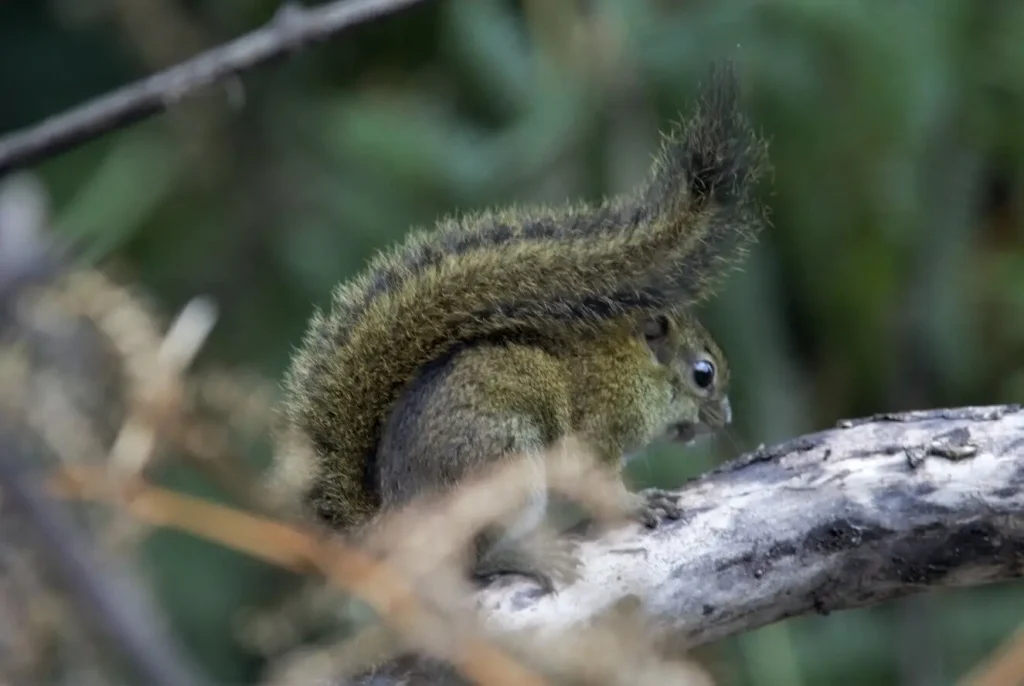
Swift and silent, the emerald runner of West Africa’s forest canopy
🔍 Quick Facts
- Common Name: Green Bush Squirrel
- Scientific Name: Paraxerus poensis
- Family: Sciuridae (Squirrels)
- IUCN Status: Least Concern
- Habitat: Lowland and montane forests, secondary woodlands
- Activity: Diurnal (active by day), arboreal
🌍 Distribution and Habitat
The Green Bush Squirrel is native to West and Central Africa, including:
- Ghana, Côte d’Ivoire, Sierra Leone, Nigeria, and Cameroon
In the Tano River region, it is found:
- In primary and secondary forests
- Along the riparian zones of the Tano River
- Around the Tanoé-Ehy Forest Reserve, in tree canopies and undergrowth
Its presence is often revealed by the sound of rustling leaves above.
🐿 Appearance
- Color: Olive-green to grey-green fur, helping it blend with the forest canopy
- Underparts: Lighter yellowish or cream-colored
- Tail: Long and bushy, used for balance
- Size: About 15–20 cm body length; tail nearly as long
Its muted greenish coat makes it well-camouflaged among mossy tree trunks and lianas.
🌿 Behavior and Ecology
- Diurnal and arboreal: Spends most of its life in trees
- Extremely agile: Leaps from branch to branch with precision
- Diet:
- Fruits, nuts, seeds, insects, and tree bark
- May also eat mushrooms or sap
Known to be curious but cautious, it often freezes when disturbed.
🪺 Nesting and Reproduction
- Builds leafy nests high in trees, similar to bird nests
- Breeds once or twice a year depending on food availability
- Gives birth to 2–4 young, which are raised in the nest
Young squirrels develop quickly and start exploring within weeks.
🧭 Ecological Importance
- Helps in seed dispersal, especially for native tree species
- Contributes to forest regeneration by burying seeds
- Prey for birds of prey, snakes, and carnivorous mammals
- Indicator of healthy tree cover and forest connectivity
Its presence is a good sign that tree diversity and food webs remain intact.
⚠️ Threats
Although widespread and not currently endangered, the Green Bush Squirrel faces:
- 🌳 Loss of forest cover due to agriculture and logging
- 🔥 Habitat fragmentation, isolating populations
- ⚠️ Predation in open or degraded areas
It thrives best in mature, multi-layered forests like those near the Tano.
🌊 Why It Matters for the Tano River
The Green Bush Squirrel is:
- A forest acrobat, essential to the health of the canopy
- A discreet disperser of seeds that shapes future forests
- A symbol of the quiet life that flourishes above the river
Protecting its habitat helps preserve the entire vertical ecosystem, from forest floor to canopy.
🔗 Have you spotted a squirrel darting across branches in your village or farm? Share your story or photo at [TanoRiver.com/submit]


