



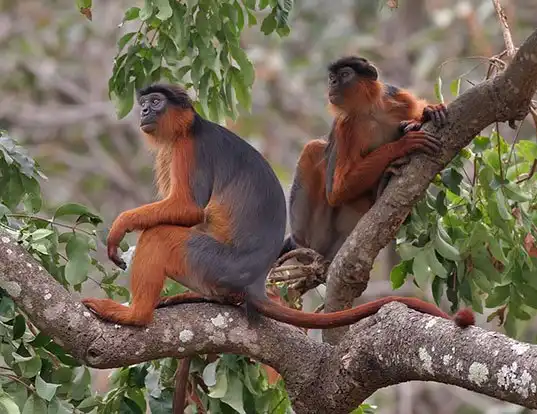
A tiny guardian of the forest canopy, hidden among the leaves of the Tano
🔎 Scientific Name: Procolobus verus
Common names: Olive colobus, Green colobus, Van Beneden’s colobus
Family: Cercopithecidae (Old World monkeys)
IUCN Status: Vulnerable
🌍 Habitat and Distribution
The Olive Colobus is one of the smallest and most elusive African monkeys. It is native to the Upper Guinean rainforest zone, found in:
- Sierra Leone, Liberia, Côte d’Ivoire, Ghana, and occasionally in Guinea
In the Tano River ecosystem, it is present:
- Deep within the Tanoé-Ehy Forest Reserve (southeastern Côte d’Ivoire)
- Along swampy rainforest corridors near the river and adjacent wetlands
- Possibly in patches of preserved canopy near the Ghanaian border
This species is highly dependent on undisturbed, dense forests for survival.
🐒 Physical Description
- Size: 45–70 cm (body), with a 50–80 cm tail
- Weight: Around 4 kg (males slightly larger than females)
- Coloration:
- Olive-green to greyish-brown fur
- Light underparts and darker limbs
- Small face, short snout, and expressive eyes
- Tail: Long and non-prehensile, used for balance
It is the smallest of all African colobus monkeys and one of the least studied.
🌿 Behavior and Ecology
- Arboreal and shy: spends nearly all of its life in the upper forest canopy
- Highly cryptic: moves slowly and quietly to avoid predators
- Diet:
- Primarily young leaves, also eats buds, fruit, and flowers
- Has a complex, multi-chambered stomach to digest tough foliage
Social behavior:
- Lives in small groups or blends with other monkey species (especially Diana monkeys)
- Polygynous mating system, with one male and several females
- Communicates with soft calls, gestures, and tail flicks
Its discreet habits and camouflage make it rarely seen even by researchers.
🍼 Reproduction
- Females give birth to one infant after a gestation of about 5 months
- Infants cling to their mother’s belly and are weaned over several months
- Births often occur during the rainy season, when food is abundant
🧭 Cultural and Scientific Importance
- Locally unknown in many communities due to its secretive nature
- Not hunted as frequently as larger primates but still affected by:
- Habitat destruction
- Snares and traps
- Loss of fruit trees and undergrowth
Scientists regard it as a “flagship species” for conserving lowland swamp forests.
⚠️ Threats
The Olive Colobus is classified as Vulnerable due to:
- ❌ Severe habitat loss from:
- Logging
- Gold mining (galamsey)
- Cocoa expansion
- ❌ Fragmentation of forest corridors, isolating small populations
- ❌ Occasional hunting for bushmeat or traditional medicine
Without large, continuous forests, this monkey cannot survive.
🛡️ Conservation Efforts
- Protected within the Tanoé-Ehy Forest Community Conservation Project
- Listed on Appendix II of CITES
- Featured in primate conservation campaigns across West Africa
- Needs:
- Long-term forest protection
- Research funding
- Community-based protection programs
🌊 Why It Matters for the Tano River
The Olive Colobus is:
- A rare treasure of West Africa’s remaining rainforests
- A species that depends entirely on the forest-water connection
- A reminder that the health of the Tano River begins in the trees above it
Where the river runs through silence, the Olive Colobus moves — unseen, but watching.
🔗 Have you ever heard tales of tiny monkeys hiding high in the Tano forests? Share your observations or traditional stories at [TanoRiver.com/submit]


