




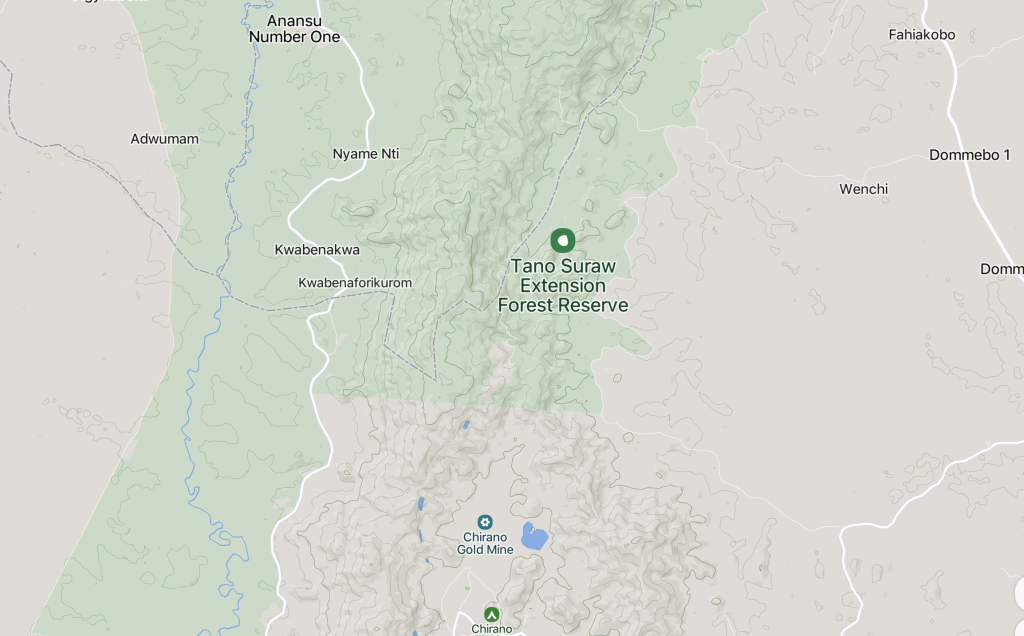
On the western edge of Ghana’s forest frontier, the Tano Suraw Extension Forest Reserve emerges as a critical yet often overlooked landscape. It lies at the intersection of two urgent priorities: preserving the upper catchments of the Tano River Basin and protecting the last strongholds of Ghana’s rainforest biodiversity.
Serving as an extension to the original Tano Suraw Forest Reserve, this protected area is a symbol of both continuity and fragility. As pressures from illegal mining, cocoa expansion, and logging increase, the Tano Suraw Extension stands as a green bulwark defending the river’s health, the forest’s integrity, and cultural heritage rooted in the sacred Tano River.
📍 Location and Overview
- Region: Western North Region, Ghana
- Districts: Bia West and Aowin municipalities
- Area: Approx. 12,500 to 15,000 hectares (est.)
- Ecosystem: Moist semi-deciduous rainforest, rich in biodiversity
- Hydrology: Within the Tano River Basin, near the Bia-Tano watershed divide
- Status: Gazetted as a Forest Reserve Extension; governed by Ghana’s Forestry Commission
Together with the original Tano Suraw Reserve, the Tano Suraw Extension forms a conservation block that provides ecological connectivity between the Tano, Bia, and Ankasa river systems.
🌊 Role in the Tano River Watershed
The Tano Suraw Extension occupies the upper to middle catchment zone of the Tano River’s western tributaries. It plays a critical hydrological role, including:
- Regulating flow into the Tano and adjacent river systems
- Filtering sediments and pollutants through riparian vegetation
- Storing rainfall and releasing it gradually, mitigating flood and drought risks
- Supporting microclimatic stability, including rainfall patterns and humidity retention
Without this forested buffer, the Tano River would face greater erosion, increased siltation, and unstable seasonal flow—all of which affect downstream agriculture, fishing, and water security.
🌿 Biodiversity
Like much of the Upper Guinean Rainforest zone, the Tano Suraw Extension hosts a treasure trove of wildlife—some of which may not yet be documented.
Mammals
- Olive Colobus Monkey (Procolobus verus) – Endangered
- Diana Monkey, Lowe’s Monkey, Black Duiker
- Bay Duiker, Palm Civet, Golden Cat (rarely seen but possibly present)
- Pangolins, both white-bellied and black-bellied species
- African dwarf crocodiles and otters along river fringes
Birds
- Likely habitat for rare species such as the White-breasted Guineafowl, Black-casqued Hornbill, and Rufous Fishing Owl
- Presence of over 180–200 bird species, making it a potential Important Bird Area (IBA)
Amphibians & Reptiles
- Endemic frogs, reed frogs, and forest geckos
- Slender-snouted crocodile (Mecistops cataphractus)—Critically Endangered
- Presence of tortoises, monitor lizards, and rare chameleons
🧭 Cultural and Sacred Relevance
The Tano River, venerated across Akan-speaking communities, is considered a deity—Tano Kɔkɔrɛ, guardian of justice, healing, and balance. Forests such as Tano Suraw Extension, located near river origins and sacred groves, are spaces of spiritual engagement:
- Shrines, sacred pools, and ancestral tree stands are part of oral tradition
- Elders speak of ritual sites in the forest where libations, oaths, and offerings are still made
- The forest is also respected as the dwelling of river spirits, particularly near small waterfalls and quiet glades
The spiritual protection of the forest has historically acted as a conservation mechanism. As this protection fades, formal conservation must now step in.
⛔ Threats to the Forest Reserve
1. Illegal Mining (Galamsey)
- Active prospecting near the riverbanks of western tributaries
- Mercury and sedimentation threaten aquatic and human life
- Forest is cleared rapidly to access alluvial gold deposits
2. Logging and Timber Exploitation
- Valuable species like Mahogany, Odum, and Wawa are illegally harvested
- Timber roads fragment habitats and lead to increased poaching
3. Agricultural Encroachment
- Cocoa farm expansion has encroached into buffer zones
- Slash-and-burn techniques destroy understory vegetation and degrade soils
4. Lack of Monitoring and Documentation
- Limited biodiversity surveys mean most data is extrapolated from nearby reserves
- This limits visibility and weakens advocacy for stronger protections
💚 A Key Target for the Tano River Collective Project
The Tano Suraw Extension Forest Reserve must become a core focus of the Tano River Collective Project. Its strategic location, rich ecosystems, and role in river protection make it ideal for coordinated, multi-stakeholder conservation.
Project Goals:
- Map the biodiversity through field research and community observations
- Launch youth engagement programs, focusing on traditional river lore and modern forest conservation
- Establish forest monitoring teams drawn from local communities and schools
- Restore degraded zones along watercourses using native species
- Protect sacred sites through legal recognition and community co-management
- Collaborate with national bodies and international NGOs to bring visibility to this endangered ecosystem
📢 Conclusion: A Forest at the Frontline of Hope
The Tano Suraw Extension Forest Reserve is more than an “extension”—it is an ecological and spiritual frontline. Its protection is not just about trees or animals. It is about respecting the integrity of the river that gives life, honoring the memory of ancestors, and providing future generations with clean water, clean air, and cultural continuity.
At TanoRiver.com, we see this forest as a symbol of what is still possible: restoration, resilience, and reconnection.
🌍 www.TanoRiver.com
Where the river begins, the forest must endure.
Join the Tano River Collective Project – Protect the source. Preserve the soul.


