




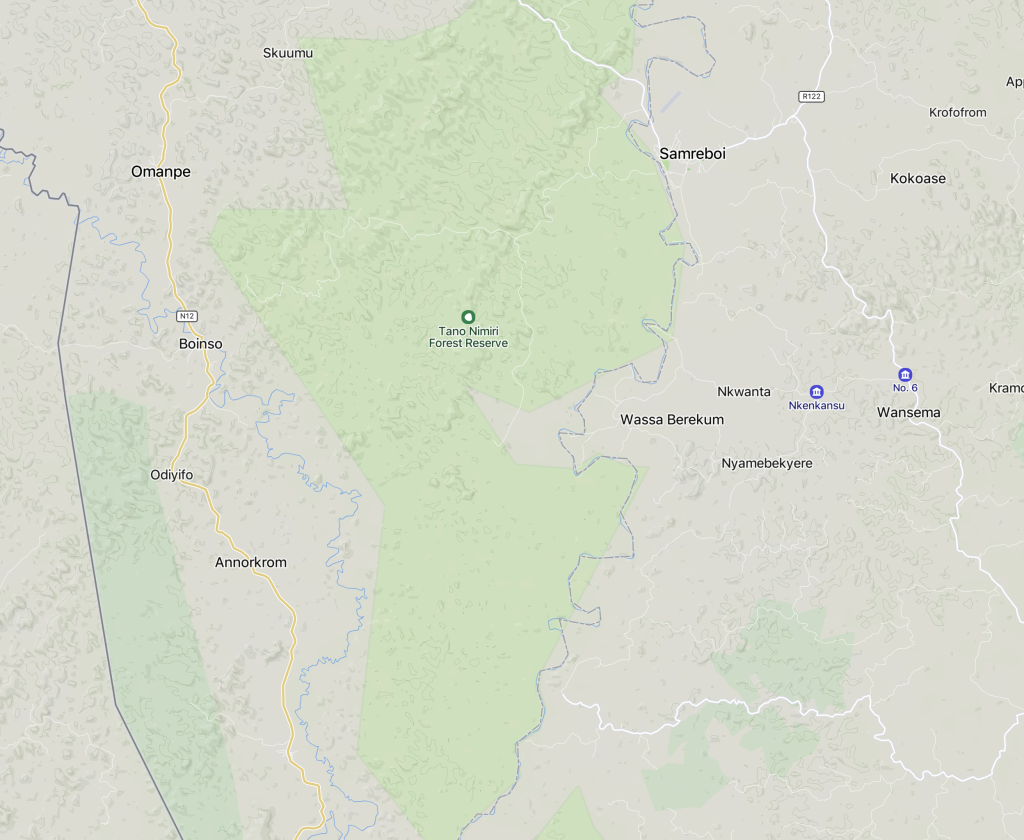
Amid the tropical forests of Ghana’s Western Region lies a largely overlooked but vital sanctuary: the Tano Nimiri Forest Reserve. Quietly nestled along the upper catchments of the Tano River, this reserve acts as a buffer between modern environmental threats and one of West Africa’s most spiritually and ecologically significant rivers.
Though it rarely captures headlines, Tano Nimiri plays an essential role in maintaining water quality, conserving biodiversity, and sustaining sacred traditions. As the Tano River faces increasing pressure from illegal mining, logging, and deforestation, protecting this forest is no longer optional—it is urgent.
📍 Location and Background
- Region: Western North Region, Ghana
- District: Aowin Municipality (near towns like Enchi)
- Size: Approximately 14,950 hectares
- Designation: Protected forest reserve under Ghana’s Forestry Commission
- Ecosystem Type: Moist semi-deciduous forest with high canopy cover and mixed undergrowth
- Proximity: Lies within the upper reaches of the Tano River Basin, just before the river crosses into Côte d’Ivoire
Together with Tano Anwia, Boin Tano, and Tano-Offin, the Tano Nimiri Forest Reserve forms a critical node in a network of ecological strongholds tied to the life of the Tano River.
🌊 Hydrological Importance
The Tano River, which originates from the hills near Techiman and flows over 400 km into the Aby Lagoon of Côte d’Ivoire, passes close to or through the Tano Nimiri reserve zone.
This forest reserve:
- Protects upper river tributaries that feed into the main Tano channel
- Maintains seasonal water flow through soil retention and evapotranspiration
- Filters runoff and sediment, ensuring water purity for communities downstream
- Helps regulate microclimates across the region, providing stability in rainfall and temperature
In effect, Tano Nimiri functions as a green filter and natural dam—absorbing and releasing water in tune with the rhythms of the land.
🐾 Biodiversity
While less studied than other forest reserves, Tano Nimiri is part of the Upper Guinean Rainforest Zone—a globally recognized biodiversity hotspot. The reserve likely harbors many species also found in adjacent reserves such as Tano Anwia and Boin Tano.
Likely Fauna (based on ecological similarity)
- Olive Colobus Monkey (Endangered)
- Diana Monkey, Lowe’s Monkey, and Black Duiker
- Yellow-backed Duiker, Maxwell’s Duiker
- African Golden Cat, Palm Civet, Bongo Antelope
- Crocodiles and otters near riverine areas
Birds
- Hornbills, Turacos, Sunbirds, and forest woodpeckers
- Potential nesting areas for threatened migratory species
- Likely qualifies as an Important Bird Area (IBA) if surveyed
Flora
- African mahogany (Khaya spp.), Wawa, Odum (Milicia excelsa)
- Medicinal plants used by local herbalists
- Understory filled with ferns, shrubs, and lianas typical of transitional forests
🧭 Cultural and Spiritual Significance
In Akan cosmology, the Tano River is a sacred deity, often called Tano Kɔkɔrɛ. Forests like Tano Nimiri are not just natural resources—they are ancestral spaces. Elders and priests speak of sacred groves and hidden water spirits that dwell near forest streams and springs.
- Shrines near the reserve are used during seasonal libations and rain rituals
- Forest sections are protected by traditional taboos, including no-hunting zones and tree felling prohibitions
- Oral traditions link the forest to stories of judgment, fertility, and protection
Preserving this forest, therefore, honors not only biodiversity, but the spiritual identity of the communities who have lived alongside the river for centuries.
⛔ Threats to the Tano Nimiri Reserve
Despite its importance, Tano Nimiri is under rising threat from human activities:
1. Illegal Mining (Galamsey)
- Gold miners are targeting riverbanks within and near the reserve
- Mercury and chemical runoff are poisoning the water table and river tributaries
- Forest is being cleared to access mineral-rich soils
2. Logging
- High-value timber species are being harvested illegally, often under cover of darkness or with forged permits
- Logging roads fragment wildlife corridors and accelerate erosion
3. Farming and Encroachment
- Expansion of cocoa farms and slash-and-burn agriculture has led to the loss of buffer zones
- Pressure from nearby villages and landless youth adds to deforestation
💚 The Role of the Tano River Collective Project
The Tano River Collective Project positions itself as a guardian of the entire Tano River system—from its source to its delta. The Tano Nimiri Forest Reserve is a critical part of this vision.
Strategic Goals for Tano Nimiri:
- Conduct Biodiversity Assessments
- Partner with universities and conservation NGOs to map species
- Identify Key Biodiversity Areas (KBAs) and sacred ecological zones
- Engage Local Communities in Protection
- Support traditional authorities with tools for monitoring and enforcement
- Establish Community Resource Management Areas (CREMAs)
- Reforest Degraded Zones
- Train youth in agroforestry and native tree nursery techniques
- Launch riverbank restoration campaigns
- Advocate for Stronger Forest Protection Policies
- Work with the Forestry Commission to review enforcement frameworks
- Connect local struggles to national and international conservation goals
- Celebrate the Forest Through Culture
- Organize cultural festivals honoring the river and forest spirits
- Document and share oral histories, proverbs, and rituals tied to the land
📢 Conclusion: A Forest at the Crossroads
The Tano Nimiri Forest Reserve stands between two futures. One is paved by indifference and destruction, where the trees fall silent, and the river loses its guardians. The other is carved by memory, resilience, and unity—where communities rise to protect the very spirit of their land.
TanoRiver.com calls on all who care—scientists, villagers, youth, and diaspora Africans—to choose the second path. Together, let’s keep the forest breathing and the river flowing.
🌍 www.TanoRiver.com
Tano Nimiri: Where Trees Remember, and Rivers Speak.
Join the Tano River Collective Project today.


