




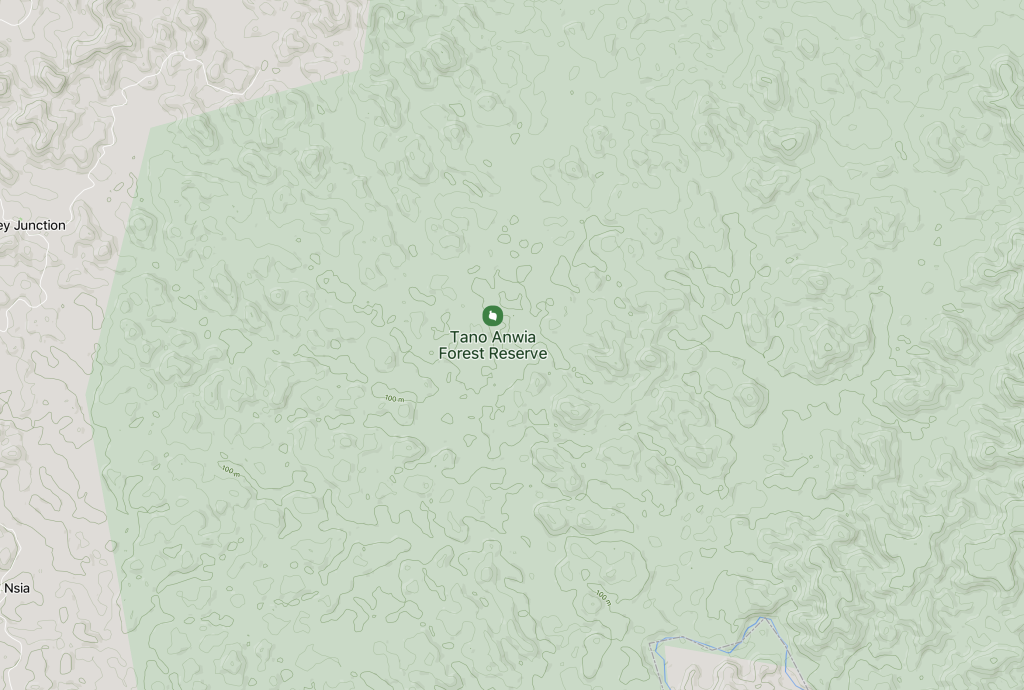
Amid Ghana’s mosaic of tropical forests, the Tano Anwia Forest Reserve remains one of the lesser-known yet ecologically critical sanctuaries of the Tano River Basin. Located in the Western North Region, this reserve quietly supports the life of an entire river system, shelters endangered species, and upholds traditional spiritual values long revered by the Akan peoples.
As the pressures of deforestation and illegal mining grow in the region, Tano Anwia’s strategic and symbolic importance is emerging as a linchpin in the conservation of the Tano River watershed.
📍 Location and Overview
- Region: Western North Region, Ghana
- District: Aowin Municipality and parts of Sefwi-Wiawso
- Size: Approximately 16,146 hectares (161.5 km²)
- Established: Gazetted in the early 1940s as a protected area
- Management: Supervised by the Ghana Forestry Commission
The reserve is part of the Upper Guinea Forest Zone, one of the most biologically diverse regions on the African continent. Its proximity to the upper Tano River makes it crucial for watershed protection, biodiversity conservation, and climate resilience in southwestern Ghana.
🌊 Hydrological Role in the Tano River Basin
The Tano River, which originates near Techiman in central Ghana, receives multiple tributaries from forested catchments like Tano Anwia. These headwaters contribute to:
- Maintaining perennial flow even in dry seasons
- Filtering sediments and pollutants
- Recharging groundwater and stabilizing local microclimates
- Preventing flash flooding in downstream areas
The Tano Anwia Reserve, therefore, acts as a green sponge that sustains the upper Tano Basin’s hydrological rhythm.
🌿 Biodiversity and Wildlife
Despite being less surveyed than more famous reserves, Tano Anwia is believed to host a rich but under-documented array of species, including rare and endemic flora and fauna.
🌱 Flora
- Dominated by evergreen and moist semi-deciduous forest species
- Trees include Triplochiton scleroxylon (wawa), Khaya anthotheca (African mahogany), and Terminalia superba
- Understory rich in medicinal plants, lianas, and ferns
🐒 Mammals (likely and historically present)
- Olive Colobus Monkey (Endangered)
- Lowe’s Monkey, Black-and-white Colobus
- Maxwell’s Duiker, Bay Duiker
- Bongo Antelope, African Golden Cat, and African Civet
🐦 Birds
The reserve falls within the migratory route of Afrotropical forest birds:
- Turacos, Hornbills, Sunbirds
- Possibly endangered species like the Nkulengu Rail and Rufous Fishing Owl
🦎 Reptiles and Amphibians
- Likely habitat for slender-snouted crocodiles along water margins
- High probability of endemic frogs and forest geckos
🧭 Cultural and Sacred Value
For centuries, the Tano River and surrounding forests have held spiritual significance for the Akan people, particularly the Aowin, Sefwi, and Ahanta communities.
- The river deity Tano is believed to inhabit sacred pools and forest springs within or near Tano Anwia.
- Shrines and sacred groves exist in parts of the forest, where access is restricted or governed by taboos.
- Traditional festivals and libation rituals still occur in villages adjacent to the reserve, reinforcing the forest’s cultural role.
Preserving Tano Anwia is therefore both an ecological and spiritual duty.
⛔ Environmental Threats
1. Illegal Mining (Galamsey)
- Gold mining operations are encroaching upon the Tano watershed.
- Mercury contamination threatens river life and downstream communities.
- Forest cover is cleared to access mineral-rich soil.
2. Logging and Timber Extraction
- High-value hardwood species are illegally harvested.
- Logging roads fragment habitats, opening the forest to further degradation.
3. Cocoa Farming and Shifting Cultivation
- Pressure from population growth and market-driven agriculture leads to encroachment.
- Bush burning and pesticide runoff degrade forest soil and water.
4. Lack of Scientific Monitoring
- Tano Anwia remains one of the least studied reserves in the region.
- Limited biodiversity data weakens conservation planning and funding access.
💚 Conservation Opportunities
A Priority for the Tano River Collective Project
The Tano Anwia Forest Reserve is ripe for inclusion in strategic conservation and community engagement initiatives. Within the framework of the Tano River Collective Project, the following actions are recommended:
1. Biodiversity Mapping
- Launch a collaborative project to catalog species (flora, fauna, fungi)
- Partner with universities and local conservation groups
2. Community Stewardship Programs
- Support traditional custodians through CREMA (Community Resource Management Areas)
- Blend indigenous knowledge with modern conservation tools
3. Reforestation and Riverbank Protection
- Establish native tree nurseries with local youth
- Reforest degraded areas with riparian species to protect water flow
4. Anti-Mining Advocacy and Policy Monitoring
- Train and deploy community rangers
- Advocate for stricter enforcement of forest and mining laws
5. Eco-cultural Tourism Development
- Develop responsible tourism packages linked to sacred groves, waterfalls, and traditional ceremonies
- Empower communities with sustainable income alternatives
📢 Conclusion: A Forest to Remember, a Future to Protect
The Tano Anwia Forest Reserve may not make headlines, but it holds the roots of resilience—for nature, for culture, and for water. In an age of ecological collapse and cultural erosion, this forest offers a quiet, enduring lesson: the health of a river begins in the stillness of a tree’s shade and the depth of ancestral memory.
Let us not wait until the forest is silent.
Let us act—now.
Join us at www.TanoRiver.com
➡️ Learn. Protect. Restore.
➡️ Become part of the Tano River Collective Project


