Pipistrellus nanulus – La minuscule pipistrelle
Cet article n’est pas encore disponible en français : vous lisez la version originale en anglais. Voir la page anglaise
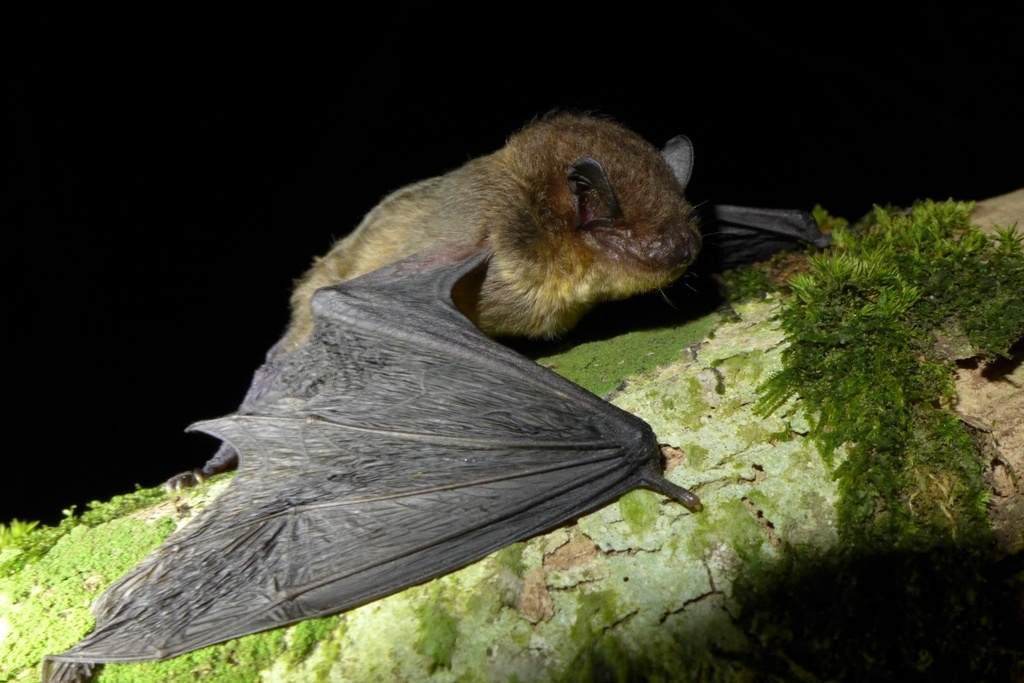
A miniature guardian of the night, fluttering softly across forest clearings and riversides
Quick Facts
- Common Name: Tiny Pipistrelle
- Scientific Name: Pipistrellus nanulus
- Family: Vespertilionidae (Evening bats)
- IUCN Status: Least Concern
- Wingspan: ~15–20 cm
- Body Length: ~3.5–5 cm
- Weight: 3–6 grams
- Activity: Nocturnal
- Habitat: Tropical forests, woodland edges, savannas, and riparian zones
Distribution and Habitat
The Tiny Pipistrelle is widely distributed in sub-Saharan Africa, including:
- Côte d’Ivoire, Ghana, Nigeria, Cameroon, Liberia, and beyond
In theTano River Basin, it likely roosts and feeds:
- Along forest trails, riverbanks, and wetland edges
- Inside tree hollows, under bark, or in thatched roofs
- Near water bodies, where insects are abundant
It prefers sheltered roosting sites and emerges at dusk to forage in open airspace.
Appearance
- Fur: Brown or grayish-brown, sometimes with a slight reddish hue
- Face and ears: Small, with short rounded ears
- Wings: Narrow and short, built for agile, fluttering flight
- Tail: Short and partially enclosed in the tail membrane
Despite its size, it is a confident and efficient flyer, often feeding close to vegetation.
Behavior and Diet
- Diet:
- Flying insects such as moths, mosquitoes, beetles, midges
- Hunts using echolocation, emitting ultrasonic pulses while in flight
- Frequently seen dancing under canopy gaps or hovering near water
Its tiny size allows it to exploit microhabitats in dense forest.
Reproduction
- Breeding likely follows seasonal rainfall patterns
- Gestation: ~6–8 weeks
- Gives birth to 1–2 pups, which cling to the mother or remain in a warm roost
- Young reach flight capability in just a few weeks
Colonies are typically small and scattered, sometimes forming in shared shelters with other bat species.
Ecological Importance
The Tiny Pipistrelle contributes to:
- Insect population control, including vectors like mosquitoes
- Serving as prey for owls, snakes, and nocturnal predators
- Supporting ecosystem balance in wetlands, forest edges, and agroforestry zones
It is one of the quiet champions of mosquito regulation in the Tano basin.
Conservation Concerns
Although listed as Least Concern, the species may face:
- 🪓 Deforestation and loss of natural roosting trees
- 🏠 Loss of traditional buildings, which sometimes offer alternative shelters
- 🧪 Insecticide use, reducing prey availability
- 🔍 Under-monitoring, due to its small size and subtle presence
Protecting small roosts, insect-rich corridors, and old trees is essential.
Why It Matters for the Tano River
The Tiny Pipistrelle is:
- A miniature engine of balance, flitting through night air over the Tano
- A vital part of the invisible food web between forest canopy and water
- A reminder that size does not equal significance in conservation
To protect this bat is to strengthen the web of life that connects trees, insects, water, and air.
🔗 Have you spotted small bats near your home or seen them flicker across a forest trail at dusk? Share your observations at [TanoRiver.com/submit]