Hyemoschus aquaticus – Le chevrotain aquatique
Cet article n’est pas encore disponible en français : vous lisez la version originale en anglais. Voir la page anglaise
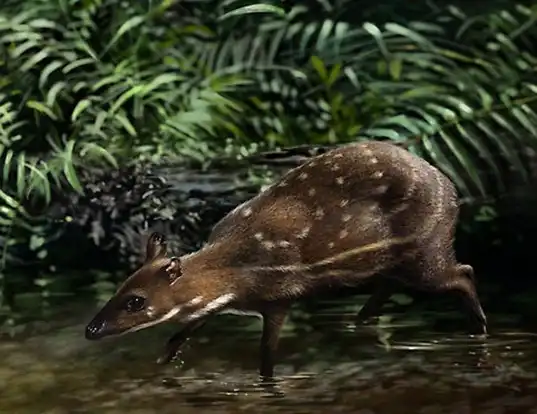
A shy, gliding spirit of West Africa’s riverside forests, walking the line between deer and mystery
Quick Facts
- Common Name: Water Chevrotain
- Scientific Name: Hyemoschus aquaticus
- Family: Tragulidae (Chevrotains or Mouse-deer)
- IUCN Status: Least Concern, but locally threatened
- Size: ~40–85 cm body length; ~7–16 kg
- Height: ~30–35 cm at the shoulder
- Activity: Nocturnal and crepuscular
- Habitat: Dense tropical lowland forests near water
Distribution and Habitat
The Water Chevrotain is native to the tropical rainforests of West and Central Africa, including:
- Côte d’Ivoire, Ghana, Liberia, Nigeria, and the Congo Basin
In theTano River Basin, it likely inhabits:
- Riparian forest strips, especially near quiet tributaries and lagoons
- Dense undergrowth of the Tanoé-Ehy Forest Reserve
- Areas with low disturbance, where it can remain hidden
It avoids open spaces and is rarely seen, often known only by hoofprints and rustling.
Appearance
- Body: Rounded and compact, with short legs and arched back
- Fur: Reddish-brown with white horizontal stripes and spots on the flanks
- Eyes: Large and dark, adapted for low light
- Tail: Short and often flicking when alarmed
- No antlers or horns, but males have small curved tusks
It resembles a miniature deer, but is actually more ancient in lineage.
Behavior and Diet
- Nocturnal, emerging at dusk to forage
- Diet:
- Fallen fruit, mushrooms, leaves, and sometimes insects or crabs
- Uses streams and shallow water to escape predators — it is a surprisingly good swimmer
- Very secretive; prefers to freeze or bolt into cover when disturbed
Leaves behind small hoofprints with two pointed toes.
Reproduction
- Solitary except during mating
- Females give birth to a single fawn after a gestation of ~4–5 months
- Fawns are hidden in thick vegetation, with excellent camouflage
- Maturation is slow, and sexual maturity occurs around 9–12 months
Breeding behavior is still not fully observed in the wild.
Ecological Role
The Water Chevrotain contributes to forest health by:
- Spreading seeds from consumed fruit
- Supporting predators such as pythons, leopards, and crowned eagles
- Maintaining balance in the understory browsing community
It is also a living fossil, representing one of the most primitive ungulate lineages.
Conservation Concerns
While globally Least Concern, the species is vulnerable in West Africa due to:
- 🪓 Deforestation and logging
- 🏞 Fragmentation of riparian corridors
- 🧱 Poaching for bushmeat
- 🔥 Habitat degradation due to mining and farming pressure
Its dependence on dense vegetation and water access makes it sensitive to change.
Why It Matters for the Tano River
The Water Chevrotain is:
- A symbol of ancient forest continuity
- A quiet guardian of riparian biodiversity
- A sign that the Tano’s forest-wetland linkages are still functioning
Its presence tells us the ecosystem is whole — from root to riverbank.
🔗 Have you found unusual hoofprints or seen a reddish flash vanish into the thickets at dusk? Report your sightings at [TanoRiver.com/submit]