Dendrohyrax dorsalis – Le daman des arbres de l’Ouest
Cet article n’est pas encore disponible en français : vous lisez la version originale en anglais. Voir la page anglaise
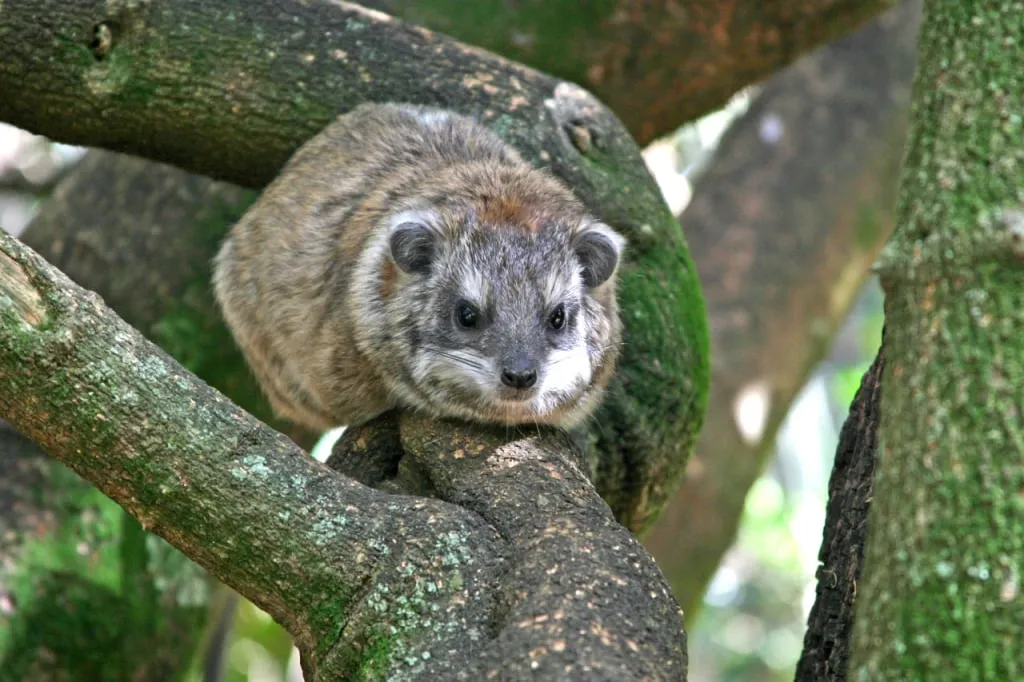
A mysterious night-caller of the Tano’s canopy, more often heard than seen
Quick Facts
- Common Name: Western Tree Hyrax
- Scientific Name: Dendrohyrax dorsalis
- Family: Procaviidae
- IUCN Status: Least Concern, but declining in many areas
- Size: 40–60 cm body length; 2–3.5 kg
- Activity: Nocturnal
- Habitat: Tropical forests, especially dense and mature canopy
Distribution and Habitat
Native to the Upper Guinean forests of West Africa, the Western Tree Hyrax is found in:
- Côte d’Ivoire, Ghana, Liberia, Sierra Leone, and Guinea
In theTano River Basin, it is:
- Most likely encountered in Tanoé-Ehy Forest Reserve
- Living in tree hollows, canopy forks, and dense foliage
- Avoiding open areas, it relies on intact forest canopy to survive and hide
Appearance
- Fur: Gray to dark brown, dense and coarse
- Body: Rounded with short limbs and no visible tail
- Feet: Specialized rubbery soles for gripping tree bark
- Face: Small round ears, forward-facing eyes
Often mistaken for a rodent, it is more closely related to elephants and manatees!
Behavior and Diet
- Nocturnal and arboreal, almost never descends to the ground
- Diet:
- Leaves, bark, young shoots, and fruit
- Occasionally lichen and moss
- Highly vocal, producing haunting screams, barks, or moans after dusk
- Uses urine scent-marking and may have tree-top territories
It’s most often detected by its distinctive night-time cries, which can sound eerily human.
Reproduction
- Solitary or loosely social
- Gives birth to a single young, usually once a year
- Offspring develop slowly and stay hidden in tree cavities
- Parental care is extended and cautious
Because they are quiet during the day, their breeding behavior remains poorly understood.
Ecological Role
The Western Tree Hyrax plays a small but essential role in the forest:
- Consumes and prunes vegetation, influencing plant growth
- Provides food for large forest predators (eagles, leopards, pythons)
- Its tree-hollow nests are sometimes reused by birds or other mammals
Its loud vocalizations also help mark territory and contribute to forest soundscapes.
Conservation Concerns
Though classified as Least Concern, it faces growing threats:
- 🌳 Deforestation and canopy fragmentation
- 🧱 Hunting for bushmeat, particularly near rural villages
- 🔥 Forest fires and agroforestry expansion
- ❌ Disturbance from logging roads that fragment high-canopy movement
It is rarely studied, so true population data may be underestimated.
Why It Matters for the Tano River
The Western Tree Hyrax is:
- A ghost of the canopy, signaling a forest still wild and deep
- A barometer of vertical forest integrity — if hyraxes are there, the trees are still connected
- A living link to Africa’s ancient ecological heritage
To hear its call in the night is to know that the upper branches of Tano still breathe.
🔗 Have you heard eerie screams at night in the forest, or seen round animals in treetops? Help track tree hyrax sightings at [TanoRiver.com/submit]