Panthera pardus – Le léopard
Cet article n’est pas encore disponible en français : vous lisez la version originale en anglais. Voir la page anglaise
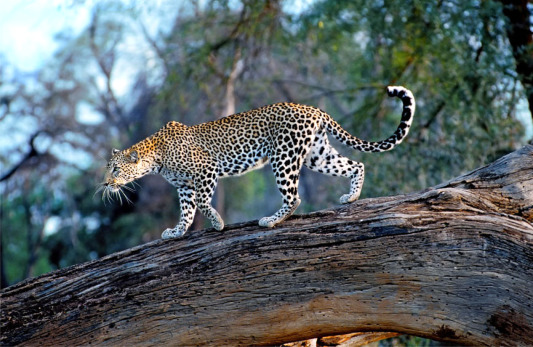
Stealth and strength in one shadow: the vanishing ruler of West Africa’s forests
Quick Facts
- Common Name: Leopard
- Scientific Name: Panthera pardus
- Family: Felidae
- IUCN Status: Vulnerable (globally), and possibly endangered in West Africa
- Activity: Nocturnal and crepuscular (active at dusk/dawn)
- Habitat: Forests, savannas, river valleys
Distribution and Habitat
The leopard once ranged widely across Africa, but today, West African populations are highly fragmented and rare. In the Tano River region, it may still be found:
- In dense forests like the Tanoé-Ehy Swamp Forest (Côte d’Ivoire)
- In remote patches of canopy along the Ghana–Côte d’Ivoire border
- Possibly in undisturbed riverine corridors, especially near protected areas
It requires large, connected habitats with dense cover and prey availability.
Appearance and Adaptations
- Size: 50–80 kg in West Africa (males), smaller than East/Southern African leopards
- Color: Golden-yellow coat with distinctive black rosettes
- Tail: Long and muscular for balance
- Eyes: Excellent night vision
Leopards are stealth hunters, able to stalk and pounce with surgical precision.
Behavior and Diet
- Solitary and highly territorial
- Hunts by stealth, often ambushing from trees or dense underbrush
- Diet: Extremely adaptable; includes:
- Duikers, monkeys, bush pigs, rodents, birds, and reptiles
- Will also scavenge and sometimes take livestock (in human-edge zones)
Leopards are known for dragging their prey into trees to avoid scavengers.
Reproduction
- Breeds year-round in tropical forests
- Females give birth to 2–3 cubs in hidden dens
- Cubs stay with their mother up to 18–24 months
Young leopards learn by following and observing their mother on hunts.
Cultural and Ecological Importance
In Akan, Nzema, and other forest cultures:
- The leopard is a symbol of power, royalty, and guardianship
- Featured in proverbs, totems, and storytelling
- Sometimes associated with river spirits or ancestral protectors of sacred lands
Ecologically, it is a keystone predator:
- Keeps prey populations in check
- Shapes animal behavior and movement patterns
- Supports a balanced forest ecosystem
Threats
In the Tano region, leopards face:
- 🚫 Habitat destruction due to mining, logging, agriculture
- 🔫 Poaching for skins, bones, and retaliation killings
- ❌ Loss of prey base, especially duikers and monkeys
- ⚠️ Human-wildlife conflict near farmlands
Their stealth makes them rarely seen, but their absence can unravel the ecosystem.
Conservation Status
- Listed as Vulnerable globally, and Critically Endangered in many West African countries
- Protected under CITES Appendix I
- May still survive in:
- Tanoé-Ehy Reserve (Côte d’Ivoire)
- Ankasa Conservation Area (Ghana)
- Undocumented forest corridors between
Needs:
- Strong anti-poaching enforcement
- Community-led habitat protection
- Better data through camera trapping and monitoring
Why It Matters for the Tano River
The leopard is:
- The top predator in the region’s food web
- A symbol of what can still be saved when we act quickly
- A living bridge between forest myth and biological reality
If the leopard disappears, so does a part of the soul of the Tano River Forest.
🔗 Do stories of the leopard still echo in your village? Has anyone seen tracks, calls, or signs in the forest? Share your story at [TanoRiver.com/submit]