Hybomys trivirgatus – La souris rayée de Temminck
Cet article n’est pas encore disponible en français : vous lisez la version originale en anglais. Voir la page anglaise
A ground-dwelling forest rodent of the Tano basin, marked by bold stripes and an elusive life beneath the canopy
Quick Facts
- Common Name: Temminck’s Striped Mouse
- Scientific Name: Hybomys trivirgatus
- Family: Muridae (Old World mice and rats)
- IUCN Status: Least Concern
- Body Length: ~10–15 cm (tail slightly shorter than body)
- Weight: ~40–90 grams
- Activity: Nocturnal
- Habitat: Moist tropical lowland forests, forest floor and undergrowth
Distribution and Habitat
The Temminck’s Striped Mouse is found in the Upper Guinean Forests of West Africa, including:
- Côte d’Ivoire, Ghana, Liberia, Guinea, Sierra Leone, and Togo
In theTano River Basin, it is likely present in:
- Primary and secondary forests along the river
- The Tanoé-Ehy Forest Reserve, especially areas with dense leaf litter
- Streambanks, rotting logs, and buttress roots in shaded areas
Its dependence on intact forest ground cover makes it a valuable ecological indicator.
Appearance
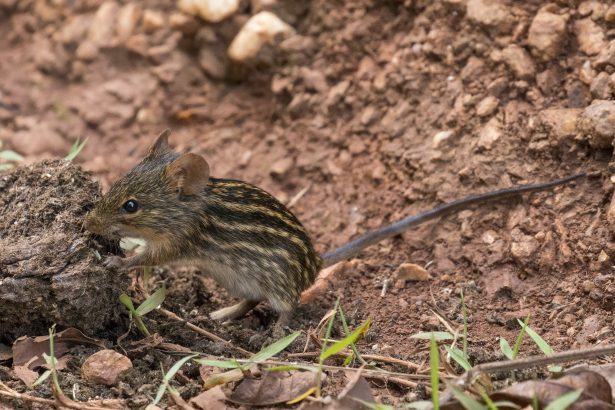
- Coat: Dark brown upperparts with three distinct pale dorsal stripes
- Underparts: Grayish-white or pale cream
- Tail: Short, hairy, and slightly bicolored
- Face: Rounded with dark eyes and small ears
The bold triple stripes on its back distinguish it from most other rodents in the region.
Behavior and Diet
- Nocturnal and mostly terrestrial, foraging under cover of night
- Diet:
- Fruits, seeds, fungi, and small invertebrates
- Nests in underground burrows or shallow depressions under logs
- Moves cautiously and rarely strays far from vegetation cover
Its activity often goes unnoticed except by signs like nibbled seeds or small runways in the litter.
Reproduction
- Likely breeds year-round in humid environments, with peaks during the rainy season
- Gestation: ~21–24 days
- Litter size: 2–5 young
- Nests lined with plant fibers, moss, or rootlets
Little is known about its courtship or family structure due to its elusive nature.
Ecological Importance
Temminck’s Striped Mouse contributes to:
- Seed dispersal and predation, affecting forest regeneration
- Soil turnover and nutrient cycling through burrowing
- Supporting predators like owls, snakes, civets, and mongooses
As a forest floor resident, it is sensitive to microclimate changes and habitat degradation.
Conservation Concerns
Though classified as Least Concern, it is locally at risk due to:
- 🌳 Deforestation, especially for logging and agriculture
- 🔥 Slash-and-burn farming, reducing forest floor shelter
- 🛤 Habitat fragmentation, which isolates populations
- 📉 Limited research, leaving its population trends poorly understood
Conservation of continuous forest canopy and understory is vital for its long-term survival.
Why It Matters for the Tano River
Temminck’s Striped Mouse is:
- A symbol of the Tano River’s hidden diversity
- An indicator species for the health of forest-floor ecosystems
- A reminder that the smallest mammals play outsized roles in the rainforest
Its survival reflects the quiet integrity of the Tano basin’s ecological web.
🔗 Have you seen striped mice or found signs of rodent activity near forest trails? Report your observations at [TanoRiver.com/submit]