Genetta poensis – La genette royale
Cet article n’est pas encore disponible en français : vous lisez la version originale en anglais. Voir la page anglaise
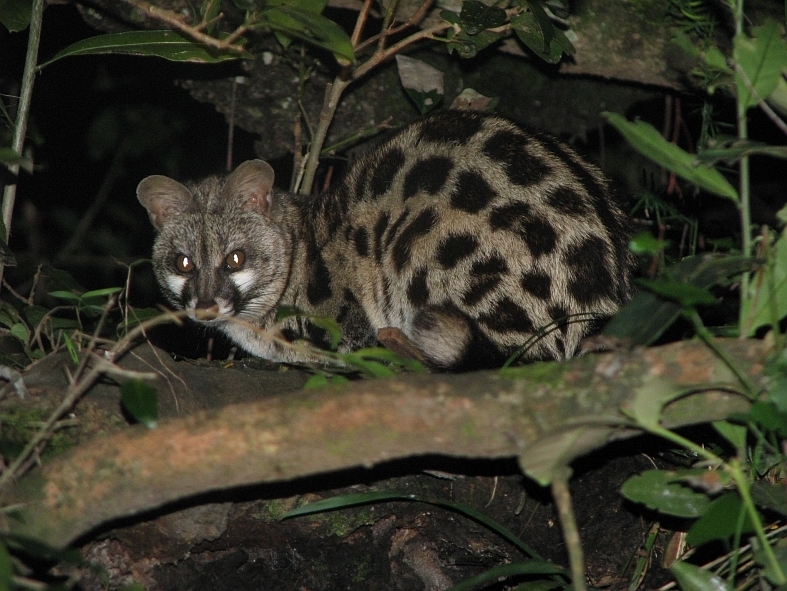
A regal shadow in the West African night, the King Genet weaves silently through the forest’s undergrowth and trees
Quick Facts
- Common Name: King Genet
- Scientific Name: Genetta poensis
- Family: Viverridae (genets and civets)
- IUCN Status: Least Concern
- Size: Body length ~40–55 cm; tail ~35–50 cm
- Weight: ~1.3–2.2 kg
- Activity: Nocturnal and solitary
- Habitat: Lowland rainforests, swamp forests, forest-savanna mosaics
Distribution and Habitat
Native to West and Central Africa, the King Genet is found in:
- Côte d’Ivoire, Ghana, Liberia, Cameroon, and surrounding countries
In theTano River Basin, it likely thrives:
- In the Tanoé-Ehy Swamp Forest Reserve
- Along forest trails, canopy crossings, and near streams or wet clearings
- In areas with dense underbrush and tree cover, offering shelter and hunting grounds
This elusive mammal is rarely seen but leaves tracks, scat, or flashes of movement behind.
Appearance
- Coat: Pale grayish to yellowish with dark spots and rosettes along its body
- Tail: Long and banded with alternating dark and light rings
- Face: Pointed muzzle, large ears, and expressive eyes
- Build: Slender, with semi-retractable claws for climbing trees and gripping prey
Its elegant form and smooth movements make it a ghost of the canopy and undergrowth.
Behavior and Diet
- Nocturnal and solitary, emerging at night to hunt
- Diet:
- Insects, small rodents, birds, frogs, reptiles
- Fruits and eggs when available
- Moves stealthily and quickly, climbing trees and hunting on the ground
- Communicates via scent marking and low vocalizations
Despite being a predator, it avoids confrontation and prefers cover and stealth.
Reproduction
- Breeding may occur year-round
- Females give birth in tree hollows or dense thickets
- Litter size: 1–4 pups
- Young remain hidden until able to forage with the mother
Very little is known about its parenting behavior, adding to its mystery.
Ecological Role
The King Genet contributes to the forest ecosystem by:
- Controlling small mammal and insect populations
- Dispersing seeds from consumed fruits
- Serving as prey for larger predators like leopards, pythons, and crowned eagles
Its adaptability to different vertical layers (ground to canopy) makes it an important link between ecosystems.
Conservation Concerns
While listed as Least Concern, threats include:
- 🌳 Deforestation and forest fragmentation, especially in coastal areas
- 🧱 Hunting and trapping for bushmeat or traditional uses
- 🚧 Loss of tree corridors, reducing movement and hunting territory
- 🔇 Low research attention, leaving population trends unclear
Protecting continuous forest cover is essential to its long-term survival.
Why It Matters for the Tano River
The King Genet is:
- A symbol of quiet balance, thriving in the space between darkness and light
- A reminder that the Tano’s forests still hold rare and graceful carnivores
- A silent predator, helping maintain rodent and insect balance in delicate ecosystems
To glimpse one is to know the forest is still wild.
🔗 Have you seen spotted animals at night, or found strange tracks in forest mud? Share your sightings at [TanoRiver.com/submit]