Cercopithecus roloway – Le singe roloway
Cet article n’est pas encore disponible en français : vous lisez la version originale en anglais. Voir la page anglaise
A sacred spirit of the forest, now fighting for survival in the shadows of the Tano
Scientific Name:Cercopithecus roloway
Common names: Roloway monkey, White-bearded guenon
Family: Cercopithecidae (Old World monkeys)
IUCN Status: Critically Endangered
Habitat and Distribution
The Roloway monkey is one of the most endangered primates in Africa. It is endemic to:
- Southeastern Ghana and southwestern Côte d’Ivoire
In theTano River region, it is:
- Confined to the Tanoé-Ehy Swamp Forest and nearby remnants of Upper Guinean rainforest
- Once widespread, now restricted to isolated patches of dense forest, including:
- Flooded swamp forests
- Evergreen lowland forests near lagoons
- Undisturbed canopy zones near sacred groves
Physical Characteristics
- Size: Head-body length 40–55 cm; tail about the same length or longer
- Weight: Males ~6–7 kg; females slightly smaller
- Distinctive features:
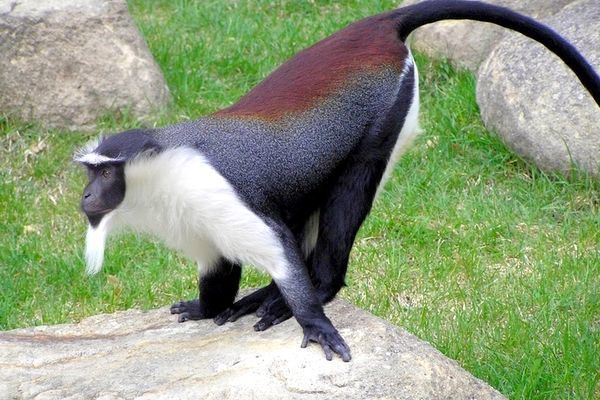
- Black body with a white throat and long white beard
- White stripe along the thigh and a reddish perineum
- Expressive brown eyes and a high-arched brow
The white beard and throat tuft make it one of the most visually striking guenons in the world.
Behavior and Ecology
- Diurnal and arboreal: active during the day, living in the forest canopy
- Social structure:
- Lives in small troops of 5–15 individuals
- Group includes one dominant male and multiple females with offspring
- Diet:
- Omnivorous, with a preference for:
- Fruits, flowers, seeds
- Occasional insects, young leaves, and resin
- Omnivorous, with a preference for:
- Role in ecosystem:
- Important seed dispersers, contributing to forest regeneration
They are silent and elusive, often staying high in the trees to avoid predators.
Cultural and Spiritual Role
In many Akan and Nzema traditions, the Roloway monkey is:
- Regarded as a symbol of forest wisdom and balance
- Protected in some areas by traditional taboos and totemic beliefs
- Referred to as a “child of the sacred groves”, especially near ancestral forests linked to the river god Ta Kora
Local legends tell of the monkey as a watcher of the forest, signaling danger and reminding humans of their duties to nature.
Threats to Survival
The Roloway monkey iscritically endangereddue to:
- 🪓 Deforestation:
- Logging, agricultural expansion, and cocoa farming
- Destruction of key forest corridors along the Tano and its tributaries
- 💣 Hunting for bushmeat:
- Despite protective laws, they are targeted for their meat and fur
- Slow reproduction and small troop size make recovery difficult
- 🏗️ Mining and Wetland Loss:
- Gold mining (including illegal galamsey) damages the forest buffer zones
- Wetlands critical for seasonal movement and safety are being drained
Less than 200 individuals are believed to survive in the wild today — most in unprotected or poorly enforced regions.
Conservation Efforts
- 🌿 Tanoé-Ehy Forest Community Reserve (Côte d’Ivoire):
- One of the last strongholds of the species
- Protected by local communities and NGOs
- Area includes key wetlands and sacred groves
- 🐾 Primate conservation programs:
- Led by groups like WAPCA (West African Primate Conservation Action)
- Focused on habitat restoration, anti-poaching patrols, and community education
- 🧒🏿 Local engagement:
- Conservation tied to cultural storytelling, youth education, and forest tourism alternatives
Why It Matters for the Tano River
The Roloway monkey is:
- A living link between forest and river
- A spirit of the canopy, sacred to both culture and ecology
- A flagship species whose protection preserves the entire wetland ecosystem
To lose it would be to lose a voice in the forest, a being that watched over the Tano long before roads and chainsaws came.
🔗 Have you seen or heard stories about the Roloway monkey? Help raise awareness by sharing at [TanoRiver.com/submit]