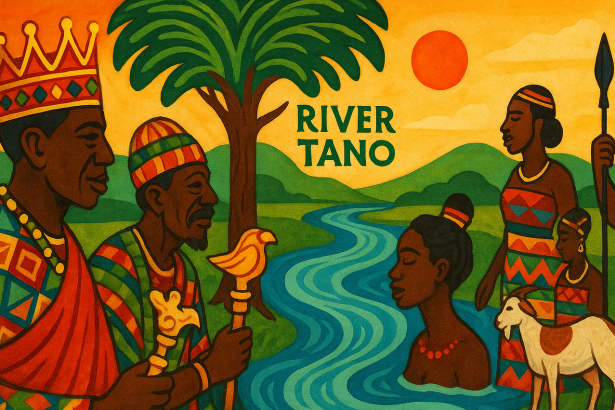
Le bosquet sacré du fleuve Tano (Tanoé) : histoire, mythe et signification
Cet article n’est pas encore disponible en français : vous lisez la version originale en anglais. Voir la page anglaise
1. Introduction: The Tano River Sacred Grove – A Living Heritage
1.1 Geographical Location and General Overview
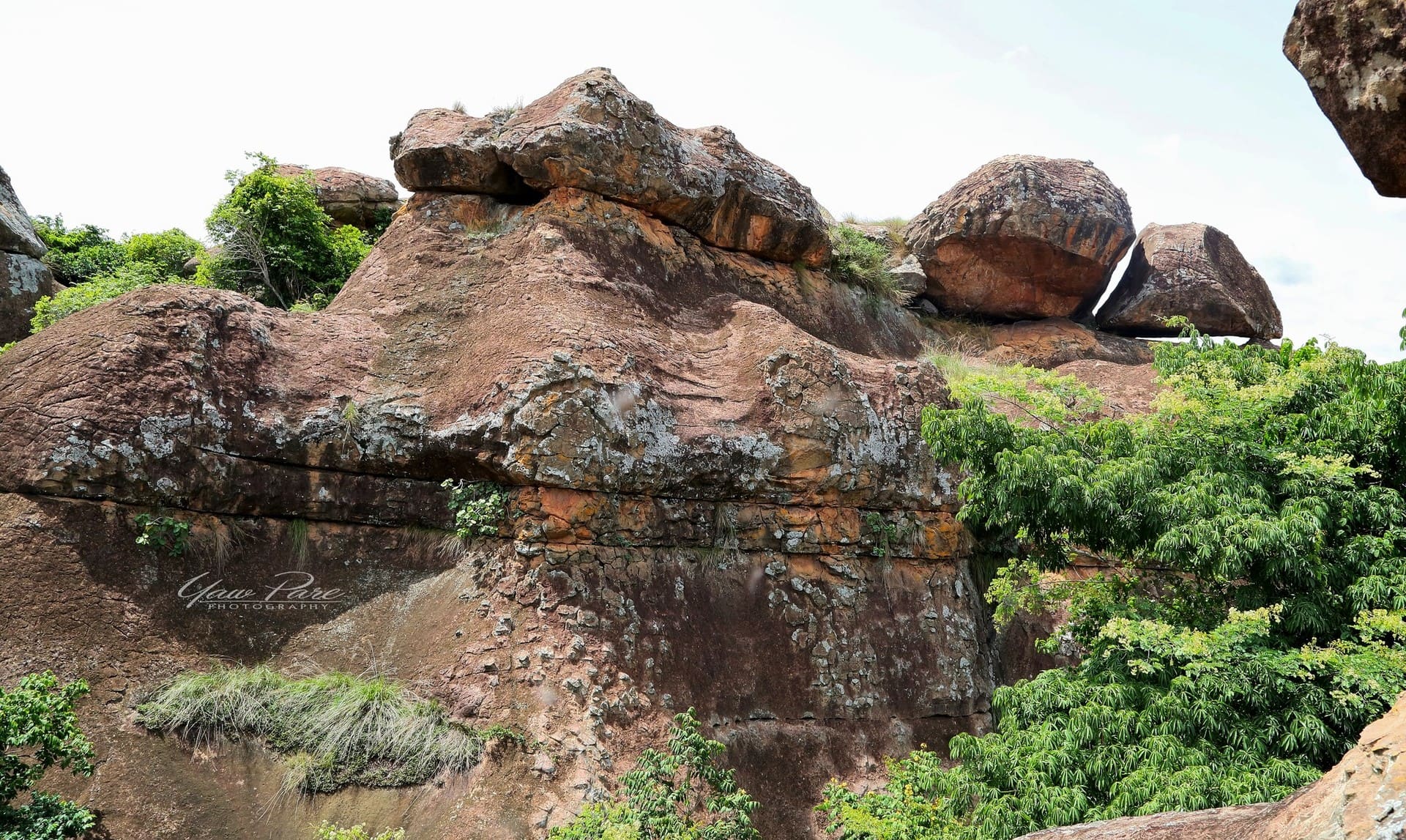
The Tano River Sacred Grove and Shrine, often referred to as Tanoboase Sacred Grove, represents a profound cultural and natural landmark situated near the village of Tanoboase, within the Techiman North Municipal Assembly in Ghana's Bono East region. This ancient forest, intrinsically linked to the Tano River from which the deity Tano derives its name, is characterized by a dense semi-deciduous forest. Within its expanse, striking sandstone rock formations are found, including sacred caves and natural shrines that are central to its spiritual identity. The grove is widely recognized as a mystical and spiritual sanctuary, embodying a unique convergence of nature, history, and tradition for the Akan people, particularly the Bono. Its intricate landscape, featuring a main entrance, durbar ground, hideout, watchtower, and stairs, highlights its historical utility and spiritual design.
1.2 Purpose and Scope of the Report
This report undertakes a comprehensive examination of the Tano River Sacred Grove, exploring its historical evolution, the rich tapestry of myths and legends that define its spiritual essence, and its multifaceted significance across cultural, ecological, and social dimensions. Furthermore, it assesses the contemporary challenges threatening its preservation and highlights ongoing and potential revitalization efforts. The scope encompasses an interdisciplinary approach, integrating anthropological, ecological, and socio-cultural perspectives to offer a holistic understanding of this vital living heritage site.
2. Historical Foundations: Cradle of the Bono People
2.1 Origins and Early Settlements of the Bono People
The Tanoboase Sacred Grove holds profound historical significance, being widely regarded as the cradle and traditional home of the Bono people. Oral traditions passed down through generations recount that the Bono people emerged from a cave named Amowi centuries ago. This emergence led to the establishment of the first centralized Akan state, initially known as the Bono-Manso kingdom, which later evolved into the Techiman-Bono kingdom. This foundational narrative firmly embeds the grove within the genesis and early societal development of the Bono people, marking it as a site of ancestral origins.
2.2 The Grove's Role in Regional Conflicts and as a Sanctuary
Throughout its history, the Tano River Sacred Grove has served as both a critical strategic point and a vital sanctuary during periods of intense conflict. Historically, the site was a battleground for Ashanti Wars, underscoring its importance in regional power dynamics and military engagements. Beyond its role in warfare, the grove's natural rock caves and dense forest provided crucial refuge for the Bono people during the tumultuous eras of the slave trade and inter-tribal wars. These caves offered essential shelter and security, often serving as hideouts for kings and entire communities, thereby playing a practical and symbolic role in the survival and resilience of the Bono people.
2.3 Evolution of Recognition: From Traditional Sanctuary to Ecotourism Site
The recognition and perceived value of the Tano Sacred Grove have undergone a significant transformation over time, evolving from an exclusively traditional and sacred sanctuary to a site also appreciated for its ecological and tourism potential. Historically, the grove has always been a central location for religious activities, deeply rooted in the indigenous religion of the Bono people.
In more recent decades, its importance has received formal acknowledgment within contemporary frameworks. In 1996, the Grove was designated a Community Based-Ecotourism Project (CBEP). This designation represented a deliberate initiative to integrate local communities into the management and benefit-sharing processes associated with the site. Subsequently, in 2001, the Sacred Grove was selected as an eco-tourism site with the support of the Ghana Association for the Conservation of Nature (GACON). This further solidified its role within Ghana's developing tourism sector. The grove is also officially recognized as an integral part of Ghana's material cultural heritage, highlighting its national importance beyond its local significance. In 2023, the Ghana Tourism Authority (GTA) formally took over the grove for redevelopment, signaling a new phase of modernization and increased visitor interest.
This historical progression, particularly the shift from a purely traditional sanctuary to a CBEP and recognized eco-tourism site, introduces a critical dynamic. While these modern designations are intended to promote conservation and economic development, they inherently introduce external pressures. Observations from similar sacred sites, such as the Osun-Osogbo Sacred Grove, indicate that the commercialization of annual festivals and increased visitor numbers can lead to adverse impacts, with economic considerations sometimes taking precedence over conservation funding. This suggests a potential challenge for the Tano Grove, where the dual imperative of preservation and modernization requires careful navigation. Effective management of the Tano River Sacred Grove necessitates a delicate balance: leveraging its cultural and natural assets for tourism and economic benefit must be harmonized with safeguarding its spiritual integrity and ecological health from potential over-commercialization, increased visitor pressure, and infrastructure development. The successful integration of traditional conservation practices with modern ecotourism models thus becomes paramount for its long-term viability.
Table 1: Key Historical Milestones of the Tano River Sacred Grove
| Period/Year | Event/Significance | Relevant Snippets |
|---|---|---|
| Ancient/Pre-colonial | Cradle and traditional home of the Bono people; emergence from Amowi cave; abode of powerful Ashanti Gods; site of Ashanti Wars; hideout during slave trade and inter-tribal wars; place for religious activities. | |
| 1996 | Designated a Community Based-Ecotourism Project (CBEP). | |
| 2001 | Selected as an eco-tourism site with support from Ghana Association for the Conservation of Nature (GACON). | |
| Ongoing | Part of Ghana's material cultural heritage. | |
| 2023 | Ghana Tourism Authority takes over for redevelopment. |
3. Mythological Landscape: Deities, Legends, and Sacred Practices
3.1 The Deity Tano (Ta Kora) and Akan Cosmology
The Tano River Sacred Grove is fundamentally defined by its profound association with the deity Tano, whose true name is Ta Kora. Within Akan cosmology, Ta Kora is a powerful Abosom (deity) embodying multifaceted attributes. He is revered as the god of war and strife, and in Asante mythology, he is specifically known as the Abosom of Thunder and Lightning. Ta Kora is also recognized as a nature god, with his identity inextricably linked to the Tano River, making him a prominent river Abosom.
His position within the Akan pantheon is significant: Ta Kora is considered the second son of Nyame, the supreme being, and Asase Ya, the earth goddess. A notable aspect of his mythology involves his enduring rivalry with his elder brother, Bia, who is also a river god. This rivalry stems from ancient myths concerning the division of fertile lands, with different versions attributing deceit to either Ta Kora or Bia regarding Nyame's promised inheritance. A unique characteristic of Ta Kora is his formidable army of baboons, which are said to protect his shrine and household, further emphasizing his connection to nature and his powerful, protective essence.
3.2 Founding Legends and Oral Traditions (e.g., the Afya Ankomah narrative)
Oral tradition forms the bedrock of the Tano River Sacred Grove's mythological narrative, meticulously passed down through generations of the Bono people. A pivotal legend central to the grove's founding recounts the manifestation of the deity Taakora to Afya Ankomah, the youngest sister of Nana Takyi Fri, a hunter. The narrative describes Afya Ankomah's encounter with a mysterious object in her fishing basket that, when removed, inexplicably caused darkness. Upon bringing this object home, she became possessed by it, and it identified itself as the river deity Asuo Tano (Ta Kora).
Following this divine encounter, Ta Kora guided Nana Takyi Fri and his family to his dwelling within the grove's rock caves, which were protected by a horde of baboons. There, the deity imparted his sacred laws and rules for living in harmony with the site. These instructions were crucial, enabling the Bono people to inhabit the rock caves, which provided essential shelter and security, and famously served as hideouts for kings during times of conflict. A significant aspect of these divine instructions was the explicit prohibition against hunting or farming within the sacred grove itself. Afya Ankomah subsequently became the first Priestess for Ta Kora, a spiritual lineage later inherited by her son, Nana Fosu Aduanwoma. This narrative is also intricately linked to the founding of the Techiman nation, as Nana Takyi Fri, after initial attempts to avoid his spiritual obligations, ultimately accepted his divine assignments following repeated interventions by Ta Kora's children. Another notable myth involves Ta Kora's struggle with Death (Owuo), leading to a compromise where Death accompanies Ta Kora into the human realm, thereby connecting the deity to the inevitability of mortality and reinforcing his role as a war god.
3.3 Rituals, Ceremonies, and Traditional Taboos
The myths and legends surrounding the Tano Sacred Grove form the fundamental basis for its traditional practices and a comprehensive system of taboos. The grove remains a site for continuous religious activities, where local communities perform rituals and offer sacrifices to seek blessings, protection, and guidance from the deity Tano. The physical Tano Shrine is maintained in Tanoboase town, but it is annually carried to the grove by a fetish priest for ceremonies.
A significant annual event tied to the grove is the Apoo festival, a week-long period of spiritual cleansing celebrated by the people of Tanoboase and Techiman, typically in April or May. During this festival, and on specific designated forbidden days such as "Apoɔ Mmurukuo," "Akwasidea," and "Kwafie," entry into the sacred caves is strictly prohibited.
The instructions given by Taakora to Afya Ankomah established foundational taboos, notably the strict prohibition of hunting or farming within the sacred grove. This is a common characteristic across sacred groves, where activities like logging, gathering firewood, and even entry for women during their menstrual cycle can be restricted. Violating these taboos is believed to invoke severe supernatural consequences, including ill-luck, diseases, untimely death, or drought. For instance, a myth warns that fetching water from the Tano River and mixing it with water from Bia's river (or vice versa) is taboo and believed to result in death, a reflection of the deities' ancient rivalry. Similarly, legends recount spiritual attacks or death for those who disrespect sacred animals, such as Ta Kora's baboons, or consume taboo items like mudfish from the Tano River. These taboos are not merely superstitious beliefs but function as powerful, indigenous conservation mechanisms, demonstrating a deep understanding of ecological balance embedded within cultural norms.
The explicit instructions given by the deity Taakora, particularly the prohibitions against hunting and farming within the grove, are not isolated mythical details; they directly translate into concrete, actionable rules that govern human interaction with the natural environment of the grove. This is further reinforced by the general Akan belief that sacred groves are the abodes of gods and ancestral spirits, and that violating associated taboos leads to supernatural sanctions. This demonstrates that indigenous myths and religious beliefs function as a sophisticated form of environmental governance, embedding conservation principles within the cultural and spiritual fabric of the community. The fear of divine retribution serves as a potent deterrent against resource exploitation, highlighting a traditional knowledge system that aligns with modern conservation goals, often proving more effective than formal laws alone.
Table 2: Principal Deities, Associated Myths, and Rituals of the Grove
| Deity/Spirit | Key Attributes/Associations | Core Myths/Legends | Associated Rituals/Practices | Relevant Snippets |
|---|---|---|---|---|
| Tano (Ta Kora) | God of war, strife, thunder, lightning, nature, river deity; second son of Nyame; protector of Bono people. | Manifestation to Afya Ankomah (founding of grove, rules); rivalry with Bia (land division); struggle with Death (compromise on human mortality); lowering river for Aowin; Asante Gyaman War (divine intervention). | Receives sacrifices for blessings/protection/guidance; shrine carried annually to grove; father of all Akan-spoken gods (rituals for fetish priests). | |
| Ancestral Spirits | Abode in the grove; provide guidance and protection. | (Implicit in sacred grove beliefs) | Ancestral worship ceremonies. | |
| Supernatural Beings | Inhabit the grove. | (General belief) | (General religious activities) | |
| Apoo Festival | Spiritual cleansing; community gathering. | (Annual celebration) | Week-long festival (April/May); "Apoɔ Mmurukuo" (forbidden day for caves); "Akwasidea," "Kwafie" (other forbidden days). | |
| General Taboos | Prohibitions against hunting, farming, logging, resource extraction. | Taakora's instructions to Afya Ankomah; rivalry between Tano and Bia (no mixing river waters); punishment for disrespecting sacred animals. | Strict observance of taboos; fear of supernatural sanctions. |
4. Multifaceted Significance: Cultural, Ecological, and Social Dimensions
4.1 Cultural and Religious Importance: Identity, Heritage, and Spirituality
The Tano River Sacred Grove serves as a cornerstone of the Bono people's cultural identity and spiritual life. It is widely believed to be the "cradle" and "traditional home" of the Bono, functioning as a powerful symbol of their origins and ancestral heritage. The belief that powerful Ashanti Gods, particularly Taakora, and ancestral spirits reside within the grove reinforces its status as a sacred abode and a focal point for spiritual reverence. The grove stands as a living testament to the rich cultural heritage of the Akan people, where the realms of nature and tradition are intricately intertwined. It is a site for continuous religious activities, rituals, and ceremonies, maintaining an unbroken connection between the community and their spiritual heritage.
The traditional conservation practices embedded within the indigenous religion, such as the prohibitions on hunting and farming within the grove, demonstrate a profound cultural and spiritual reverence for the environment. This approach to environmental management is not merely a set of rules but an integral part of their worldview. Mike Anane's observation that non-governmental organizations (NGOs) and scholars are increasingly recognizing the importance of traditional religious beliefs and culture-based knowledge systems for addressing contemporary environmental and development problems underscores the deep cultural wisdom inherent in these sites. The grove is also formally recognized as part of Ghana's material cultural heritage, highlighting its national importance.
The cultural and religious importance of the Tano Grove extends beyond mere belief; it functions as an "oasis that maintains biodiversity in culture and religious based knowledge system". This indicates that the cultural practices and religious taboos are not separate from environmental management but are deeply integrated, forming a sophisticated indigenous knowledge system. The recognition by scholars and NGOs suggests a shift from viewing these traditional practices as simple superstitions to acknowledging them as sophisticated, time-tested approaches to sustainability. The Tano River Sacred Grove exemplifies an embodied knowledge system where cultural practices, spiritual beliefs, and environmental stewardship are inseparable. This holistic approach offers valuable lessons for modern conservation, particularly in its capacity to foster community engagement and long-term sustainability through intrinsic cultural value rather than solely through external regulations. It challenges the "top-down" development models by demonstrating the efficacy of culturally embedded conservation.
4.2 Ecological Value: Biodiversity Hotspot and Ecosystem Services
The Tano Sacred Grove transcends its religious significance to function as a vital ecological treasure, serving as a critical biodiversity hotspot and providing essential ecosystem services.
4.2.1 Unique Flora and Fauna
The dense semi-deciduous forest of the Tano Sacred Grove nurtures a rich variety of plant, tree, bird, and butterfly species. It is particularly noted for its rare plant species and medicinal herbs, which are traditionally collected by local medicine practitioners to address community health needs. While specific endemic species unique to the Tano Grove are not exhaustively detailed in all available sources, sacred groves in general are widely recognized as vital repositories of local biodiversity, frequently harboring endemic and rare threatened species. The grove provides a habitat for diverse wildlife, including various species of monkeys, birds, and small antelopes. Notably, it is home to a massive population of fruit bats, which contribute significantly to the local ecosystem. The Tano River itself, originating from within the grove, supports various fish species, with catfish being particularly prevalent. The undisturbed conditions maintained within sacred groves, largely due to traditional prohibitions against activities like hunting or farming, are identified as primary factors contributing to this remarkable species richness.
4.2.2 Hydrological and Climatic Benefits
Sacred groves, including the Tano Grove, play a critical role in maintaining regional hydrological cycles and mitigating climatic hazards. The Tano River, a significant water body, takes its source directly from the Tano sacred grove. This highlights the grove's crucial function as a vital watershed, protecting the primary water source for the river and surrounding areas. Research indicates that even small sacred groves contribute to ensuring that the water table remains high in their immediate vicinity. Beyond water resource management, these groves also serve as natural windbreakers, offering protection to human settlements from severe wind and rain storms, as well as bushfires. The serene environment and towering trees within the grove collectively create a magical setting that underscores its profound ecological importance.
The consistent data demonstrates that the sacred designation of the grove directly leads to undisturbed conditions, which in turn fosters species richness and positions it as a repository of local biodiversity. This represents a direct causal relationship where the cultural and religious value translates into tangible ecological benefits, such as water source protection and habitat preservation. The characterization of these groves as "forest islands" powerfully illustrates their role as critical refugia within an otherwise degraded landscape. The Tano River Sacred Grove exemplifies how traditional reverence and cultural taboos are not merely symbolic but are highly effective, long-standing mechanisms for ecological conservation. The sacredness of the grove ensures its protection, allowing it to provide essential ecosystem services and maintain biodiversity, thereby serving as a model for community-based conservation initiatives. This suggests that integrating traditional belief systems into modern conservation strategies can significantly enhance ecological resilience.
Table 3: Ecological Contributions and Biodiversity Highlights of the Grove
| Category | Specific Contributions/Features | Relevant Snippets |
|---|---|---|
| Biodiversity Hotspot | Maintains biodiversity in culture and religious-based knowledge systems; acts as a "forest island" in degraded landscapes. | |
| Flora | Dense semi-deciduous forest; shelters rare plant species; medicinal herbs; variety of plant and tree species. | |
| Fauna | Diverse wildlife including monkeys, birds, small antelopes; large populations of fruit bats; catfish in the Tano River. | |
| Watershed Protection | Source of the Tano River; protects water sources; maintains high water table in immediate area. | |
| Climatic Regulation | Windbreakers; protects settlements from wind/rain storms and bushfires. |
4.3 Social Cohesion and Traditional Governance Structures
The Tano River Sacred Grove plays a pivotal role in fostering social cohesion and is managed through established traditional governance structures that have evolved over centuries. As the believed "cradle and traditional home of the Bono people," the grove is central to their collective identity and shared heritage. Its historical function as a hideout during periods of intense conflict would have necessitated profound communal cooperation and trust, thereby strengthening social bonds and reinforcing a shared sense of purpose. Religious activities and festivals, such as the annual Apoo festival, serve as crucial community gatherings that not only reaffirm cultural identity but also actively promote unity among local citizens and visitors.
Traditional governance structures are deeply embedded in the preservation and use of the grove. The Tanoboase sacred natural site was initially managed solely by the Tanoboase traditional council, whose guidance was rooted in ancestral customs and laws. The placement of deities along the Tano River in the upper basin, and the regulation of river use by sub-chiefs and their court of servers, exemplify this indigenous governance. Indigenous knowledge, which includes holding the river as a sacred god and prohibiting fishing, was effectively enforced by these traditional leaders, demonstrating a practical application of spiritual beliefs for resource management. The "old sages" within these communities creatively fashioned cultural traditions with the explicit goal of conserving the environment while judiciously utilizing its precious resources. The chief and the fetish priest continue to play active roles in the grove's management and spiritual oversight. Even unique social practices, such as men competing in rock climbing on the caves to acquire wives after the Apoo festival, illustrate the deep integration of the grove into the community's social fabric and rites of passage, reinforcing communal values and physical prowess.
The management of the Tano Grove is not solely based on abstract beliefs but is actively enforced by sub-chiefs and their court of servers, as well as the Tanoboase traditional council. This indicates a structured, localized governance system that translates cultural values, such as sacredness and taboos, into practical conservation measures. The community's collective identity is continually reinforced through shared rituals and historical narratives linked to the grove. The Tano River Sacred Grove exemplifies a robust model of community-based conservation where traditional authority and indigenous knowledge are central to resource management and social cohesion. This suggests that empowering and integrating these existing local governance structures is crucial for the long-term sustainability of such sites, rather than imposing external management paradigms that might inadvertently undermine local agency and traditional practices. The success of ecotourism initiatives is also directly linked to the active involvement of local people and their cultural traditions.
5. Current Status, Challenges, and Preservation Efforts
5.1 Contemporary Threats: Erosion of Traditional Beliefs, Urbanization, and Environmental Degradation
Despite its profound historical and cultural significance, the Tano River Sacred Grove, like many sacred sites in Ghana and globally, faces a range of contemporary threats that jeopardize its integrity and long-term sustainability.
A significant challenge is the erosion of traditional belief systems. The increasing influence of foreign religions and formal education can lead to a decline in adherence to traditional Yoruba beliefs, resulting in rituals and their underlying knowledge being known to fewer individuals, primarily older generations. This erosion directly undermines the very cultural edicts and taboos that have historically protected the grove, weakening its intrinsic defense mechanisms.
Urbanization and development pressures pose direct threats to the grove. Increased demand for land resources in urban areas, rapid population growth, and the need for settlement and infrastructure development exert considerable pressure. While the Tano Grove is noted to be "legally protected" , the general trend for sacred groves in Ghana is one of encroachment and degradation. Road construction and other development activities in close proximity to such properties are noted concerns for similar sites, indicating a potential future challenge for Tano.
Environmental degradation is another pressing issue. The grove is experiencing intense pressure, leading to varying degrees of deforestation and forest degradation. Human activities such as hunting, gathering of wood, and farming—activities that were historically taboo—now increasingly affect the grove's ecology. Bushfires are a recurring threat, sometimes deliberately started, causing significant damage to the forest. Furthermore, pollution of the Tano River, which originates from the grove, is a concern, mirroring issues observed in other sacred river systems.
The commercialization of tourism, while offering economic benefits, also carries inherent risks. As seen with the Osun-Osogbo Sacred Grove, the increasing commercialization of sacred sites and their associated festivals can lead to adverse impacts, with funding for festivals sometimes taking precedence over essential conservation efforts. This raises critical questions about the site's carrying capacity and the ability to maintain its spiritual atmosphere amidst growing visitor numbers.
Finally, governance gaps present a structural challenge. Indigenous institutions, despite their historical effectiveness in conservation, often face limitations due to the absence of formal bye-laws or legislative instruments to support the enforcement of indigenous knowledge. This legislative void means that traditional norms can be weakened or disregarded, compromising the long-term effectiveness of local protective measures.
The available information reveals a complex dynamic: while modern recognition through ecotourism aims to preserve the grove, the very forces of modernization—urbanization, economic pressures, and the influence of foreign religions—are simultaneously eroding the traditional belief systems and governance structures that historically protected it. This creates a vulnerability where the traditional "watchdog role" of the community is weakened, leading to increased anthropogenic pressures like logging and farming. The Tano River Sacred Grove faces a critical juncture where the long-term viability of its conservation hinges on effectively bridging the gap between traditional stewardship and modern governance. Without robust legal frameworks that validate and support indigenous knowledge, and without active community involvement that respects traditional practices, the grove risks losing its intrinsic protective mechanisms, potentially leading to irreversible ecological and cultural degradation.
5.2 The Role of Indigenous Knowledge in Modern Conservation
Indigenous knowledge systems, deeply embedded in the cultural and religious practices surrounding the Tano River Sacred Grove, offer invaluable lessons and pathways for modern conservation efforts. The traditional belief that sacred groves are the abodes of deities and ancestral spirits has historically served as a powerful and intrinsic incentive for their preservation. Prohibitions on activities such as hunting, farming, logging, and trapping within these sites, often enforced through the fear of supernatural repercussions, have effectively conserved biodiversity over centuries.
Scholars and non-governmental organizations are increasingly recognizing the profound importance of these traditional beliefs and culture-based knowledge systems in addressing contemporary environmental problems. This signifies a shift away from "top-down" paternalistic development models towards approaches that value local wisdom. Sacred groves are acknowledged internationally by bodies such as UNESCO and the International Union for Conservation of Nature (IUCN) as important reservoirs of biodiversity, playing a crucial role in preserving unique species and ecosystems. The concept of sacred groves as "traditional conservation practices" is a testament to a sophisticated indigenous environmental consciousness that predates modern conservation science.
While indigenous communities have long understood the importance of sacred groves for socio-religious life and livelihood security, a discernible gap persists between this traditional knowledge and scientific understanding regarding the groves' environmental and ecological importance. This suggests that modern scientific validation and documentation of the ecological benefits—such as detailed biodiversity inventories and comprehensive analyses of ecosystem services—can significantly strengthen the case for conservation and attract broader support. Conversely, formal institutions need to actively recognize and integrate indigenous knowledge, rather than marginalizing it, to achieve more effective and sustainable outcomes. For the Tano River Sacred Grove, bridging this knowledge gap implies fostering collaborative research that scientifically validates traditional ecological knowledge. It also necessitates developing management plans that explicitly integrate indigenous governance structures and traditional taboos with formal conservation strategies. This co-existence of customary and formal institutions offers the most robust assurance for long-term preservation, creating a model for sustainable heritage management.
5.3 Collaborative Preservation and Revitalization Initiatives
Efforts for the preservation and revitalization of the Tano River Sacred Grove are evolving, with a growing emphasis on collaborative approaches that seek to blend traditional stewardship with modern conservation strategies.
The designation of the grove as a Community Based-Ecotourism Project (CBEP) in 1996 and an eco-tourism site in 2001 signifies an early recognition of the critical need for community involvement in its management and the distribution of benefits. Studies consistently emphasize that the active participation of local people, their cultural practices, and traditions are crucial catalysts for boosting ecotourism development and ensuring that the economic advantages genuinely accrue to the community.
Recently, the Ghana Tourism Authority (GTA) formally took over the Tanoboase Sacred Grove for "redevelopment". This significant milestone aims to boost tourism and attract increased visitor interest. The CEO of the GTA emphasized the importance of "preserving cultural heritage sites... while embracing modernization and sustainable tourism practices". This indicates a formal governmental commitment to the site's future, potentially bringing increased investment and infrastructure development.
A critical area for improvement lies in the integration of indigenous knowledge and formal laws. The challenges faced by indigenous institutions due to a lack of legislative support for their traditional enforcement mechanisms highlight a significant governance gap. Recommendations advocate for the enactment of bye-laws by the Water Resource Commission basin secretariat in collaboration with local government (MMDAs) and other formal institutions to provide legal backing for indigenous knowledge. The co-existence of community-based conservation through traditional norms and formal government legislation is widely regarded as crucial for long-term preservation.
Lessons from other sacred groves in Ghana and beyond offer valuable insights. While specific detailed conservation projects for Tano are not extensively outlined in all available information, general initiatives for sacred groves in Ghana include international and local projects aimed at documenting biodiversity and piloting community-based conservation models. UNESCO-sponsored projects at other groves, such as Jaagbo, have focused on educational programs, ecotourism preparation, and documenting plant species. The Osun-Osogbo Sacred Grove, a UNESCO World Heritage Site in Nigeria, provides a comparative example of ongoing challenges (urban development, pollution, commercialization) and comprehensive responses. These responses include improved maintenance, regular river cleanings, plant regeneration, and the development of detailed conservation management and cultural tourism plans. The "New Sacred Art Movement" at Osun-Osogbo also demonstrated how artistic revitalization could contribute to preservation efforts. The use of Bio-cultural Community Protocols for other Ghanaian sacred sites also presents a potential model for Tano, offering a structured way to ensure community consent and protect traditional rights.
The recent takeover by the Ghana Tourism Authority represents a significant shift towards formal, state-led development for the Tano Grove. While this promises increased investment and tourism, it also carries the inherent risks of over-commercialization and potential marginalization of traditional governance, as observed in the case of Osun-Osogbo. The existing challenge of weak legislative support for indigenous knowledge further complicates this dynamic. Effective preservation therefore requires not just "collaboration" but a truly integrated and adaptive governance model that explicitly empowers traditional custodians, provides legal backing for indigenous taboos, and carefully manages tourism to ensure cultural and ecological integrity. The future of the Tano River Sacred Grove depends on developing a governance framework that moves beyond mere coexistence of traditional and formal systems to their synergistic integration. This means formalizing the authority of traditional councils, enacting bye-laws that enshrine indigenous conservation practices, and developing cultural tourism management plans that prioritize the grove's spiritual and ecological carrying capacity over purely economic gains. Such an adaptive approach is essential to sustain its multifaceted significance for future generations.
Table 4: Challenges and Conservation Responses for the Tano River Sacred Grove
| Category of Challenge | Specific Threats Identified | Impact on Grove | Potential/Ongoing Responses & Strategies | Relevant Snippets |
|---|---|---|---|---|
| Cultural/Social Shifts | Erosion of traditional beliefs; intergenerational disconnection; rituals known to fewer people. | Weakens traditional protective edicts; reduces community investment in spiritual significance. | Community-Based Ecotourism Projects (CBEP); integrating local culture/traditions in ecotourism planning; education and poverty alleviation (general for sacred groves). | |
| Economic/Development Pressures | Urbanization; demand for settlement/infrastructure; road construction; over-commercialization of tourism. | Encroachment; degradation; increased visitor pressure; funding for festivals prioritized over conservation. | CBEP; eco-tourism site designation; Ghana Tourism Authority takeover for redevelopment; cultural tourism management plans (comparative from Osun-Osogbo). | |
| Environmental Degradation | Deforestation; forest degradation; bushfires; pollution of Tano River; formerly taboo human activities (hunting, farming, wood gathering). | Loss of biodiversity; disruption of ecosystems; reduced water quality; physical damage to grove. | Traditional prohibitions (no hunting/farming); arrangements with fire services (comparative from Osun-Osogbo); river cleaning (comparative from Osun-Osogbo); plant regeneration/replanting (comparative from Osun-Osogbo). | |
| Governance Gaps | Lack of formal bye-laws/legislative instruments to support indigenous knowledge enforcement. | Traditional norms may be disregarded; less effective long-term protection. | Recommendation for bye-laws by Water Resource Commission & formal institutions; co-existence of customary and formal institutions. |
6. Conclusion: Sustaining a Sacred Natural Site
The Tano River Sacred Grove stands as a profound testament to the enduring interplay of history, mythology, and ecological vitality in Ghana. As the ancestral cradle of the Bono people, it embodies centuries of cultural identity, spiritual reverence for the deity Ta Kora, and a sophisticated indigenous conservation ethic rooted in powerful myths and taboos. Its historical role as a sanctuary during conflicts and its ecological value as a biodiversity hotspot and provider of vital ecosystem services underscore its irreplaceable significance.
However, the grove faces critical contemporary challenges, primarily driven by the erosion of traditional beliefs, increasing urbanization, environmental degradation, and the complexities introduced by modern tourism. The recent formalization of its management under the Ghana Tourism Authority, while promising for development, necessitates careful navigation to avoid the pitfalls of over-commercialization and the potential marginalization of traditional custodians.
Sustaining the Tano River Sacred Grove requires an integrated and adaptive governance approach. This involves not only recognizing but actively empowering traditional authorities, formalizing indigenous conservation practices through supportive legislation, and developing cultural tourism models that prioritize the spiritual and ecological integrity of the site over purely economic gains. By fostering a synergistic relationship between traditional stewardship and modern conservation strategies, the Tano River Sacred Grove can continue to thrive as a living heritage site, offering invaluable lessons for global efforts in cultural preservation and environmental sustainability.